
Mifid2 Article34 35 Eea Passporting
EU AMLR, AMLD6 & AMLA: Host FIU Reporting Rules for Cross-Border MiFID Branches
Unlike MiFID II prudential capital, anti-money-laundering supervision follows territoriality: Article 35 branches and host tied agents must file STRs directly with the host FIU under EU AMLR and AMLA rules.
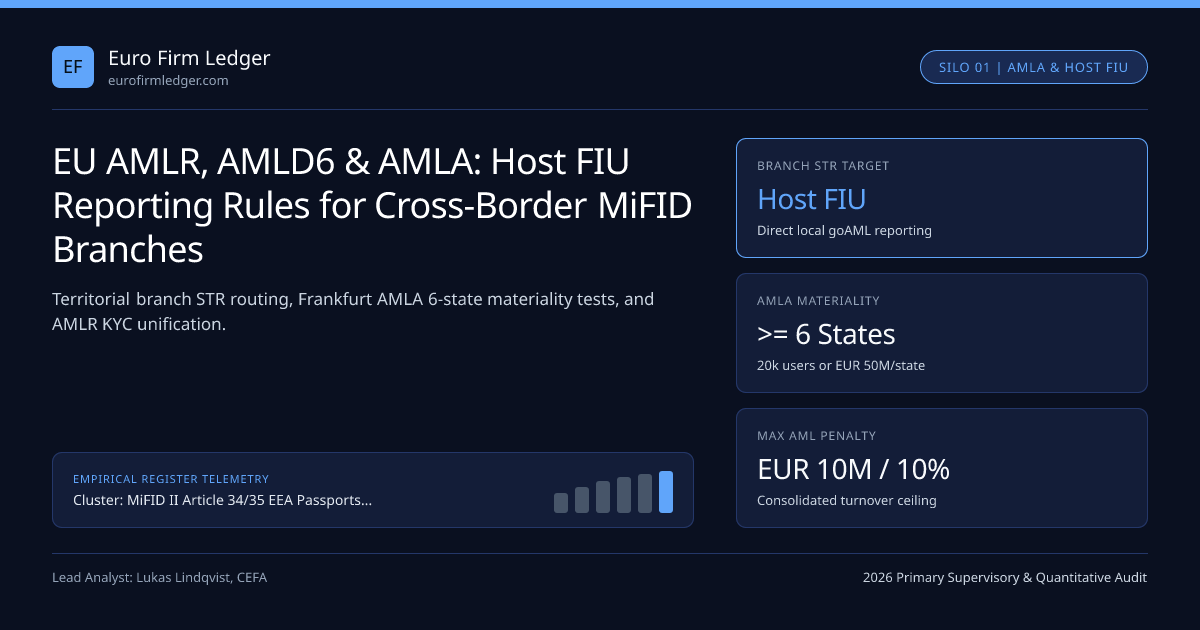
While prudential capital under EU IFR/IFD consolidates at the home regulator, European anti-money-laundering law enforces strict territoriality over physical establishments: under Directive (EU) 2015/849 Article 33(2) and its successor EU AML Package—Regulation (EU) 2024/1624 (AMLR), Directive (EU) 2024/1640 (AMLD6), and Regulation (EU) 2024/1620 establishing the Anti-Money Laundering Authority (AMLA) in Frankfurt—every MiFID II Article 35 branch and host-established tied agent must transmit Suspicious Transaction Reports (STRs) directly to the Financial Intelligence Unit (FIU) of the host member state where that establishment sits.
Within our MiFID II EEA passporting cornerstone guide and the EEA passporting hub, failing to register a local branch on the host FIU's goAML portal (such as Germany's FIU in Cologne, France's Tracfin, Spain's SEPBLAC, or the Estonian Financial Intelligence Unit) ranks among the fastest triggers for host-state on-site sanctions.
Territorial STR Routing: Remote Article 34 Passports vs Physical Article 35 Establishments#
Cross-border compliance architectures must route suspicious transaction alerts according to the exact MiFID II channel used:
- Physical Establishments & Host Tied Agents (Article 35): Host AML supervisors audit the local branch directly for AML/CFT compliance, local PEP/sanctions screening, and mandatory STR filing to the host FIU without tipping off the client.
- Remote Cross-Border Freedom of Services (Article 34): Where an EEA broker such as Bitpanda, CoinGate, or Change serves clients remotely with zero physical footprint in the host state, the firm files STRs with its home FIU, which is legally required under AMLD6 Article 53 to forward cross-border intelligence spontaneously and promptly to the relevant host FIU via FIU.net.
- Host Central Contact Point (CCP) Mandate: Under AMLD6 (expanding legacy payment/crypto rules to wider cross-border structures where proportionate thresholds are met), host member states may require out-of-state firms operating through local agents or establishments to appoint a resident Central Contact Point inside the host country to interface with the host AML supervisor and FIU.
How Frankfurt's AMLA Reshapes Cross-Border Financial Groups (Regulation 2024/1620)#
Prior to the 2024 EU AML Single Rulebook, an investment firm passporting into 20 member states had to reconcile 20 divergent national transpositions of CDD, UBO verification, and video-KYC onboarding rules (e.g., BaFin strict live-video Videoident rules vs NFC e-passport chip flows permitted by Bank of Lithuania or Austria's FMA). Under Regulation (EU) 2024/1624 (AMLR, directly applicable July 2027) and AMLA Regulation (EU) 2024/1620:
| Regulatory Dimension | Legacy 4AMLD / 5AMLD National Patchwork | Harmonized AMLR (2024/1624) & AMLA Regime | Operational Impact on Passported Firms |
|---|---|---|---|
| Remote Digital KYC Onboarding | Divergent national video-ID decrees (DE BaFin vs FR ANSSI vs CY) | Single harmonized eIDAS 2.0 / AMLA RTS technical standard | Eliminates building 12 separate country KYC funnels |
| STR Filing Portal & Schema | Unharmonized national XML formats across Tracfin, FIU DE, SEPBLAC | Standardized EU-wide STR data template issued by AMLA | Unified API schema across all Article 35 host branches |
| Cross-Border Group Selection | Fragmented national AML colleges | AMLA Direct Supervision of 40 cross-border groups operating in >= 6 Member States | Joint Supervisory Teams (JSTs) led from Frankfurt |
| Group-Wide Information Sharing | Blocked by uneven national data-privacy interpretations | Explicit AMLR group-wide STR/risk sharing within EEA groups | Head-office MLRO sees branch high-risk freezes (unless FIU bars) |
Modeling Cross-Border AMLA Selection Score & KYC Funnel Friction#
Under Article 12 of Regulation (EU) 2024/1620, an obliged credit or financial institution becomes eligible for direct AMLA Joint Supervisory Team oversight when it operates (via establishments or freedom to provide services above materiality thresholds of 20,000 host customers or EUR 50,000,000 transaction volume) in at least 6 Member States and scores in the highest residual-risk tier.
- ActiveFootprintj = 1 if (EstablishmentArt35j == 1)
- or (CustomersResidentj >= 20000)
- or (AnnualTxVolumejEUR >= 50000000)
- AMLADirectSelection_Eligibility:
- Eligible = (Sum{j=1..27} ActiveFootprintj >= 6) AND (ResidualRisk_Profile == "HIGH")
- AnnualHarmonizedeIDASKYCSavings (SkycEUR) =
- Nannualonboards * (Clegacyfragmentedvideoid - Charmonizedeidasrts)
- Worked Pan-European Neo-Broker AMLA & Onboarding Audit:
- Active in 9 Member States exceeding 20,000 clients / EUR 50M volume -> Meets >= 6 MS materiality gate
- Nannualonboards = 180,000 EEA retail users
- Clegacyfragmentedvideoid = EUR 8.40 / user, Charmonizedeidasrts = EUR 2.15 / user
- SkycEUR = 180,000 * (8.40 - 2.15) = EUR 1,125,000 annual onboarding verification savings
Central Contact Point (CCP) Powers Under Commission Delegated Regulation 2018/1108#
Where an EEA financial institution operates across host borders through networks of local agents or establishments meeting turnover and headcount triggers, host supervisors can mandate appointment of a locally resident AML Central Contact Point empowered to answer host FIU subpoenas within 24 hours and halt non-compliant local onboarding.
Avoiding Dual-FIU Tipping-Off Traps in Intragroup Escalations#
When a Madrid or Milan Article 35 branch files an urgent STR with Spain's SEPBLAC or Italy's UIF, the local branch MLRO must immediately notify the group-level MLRO at head office (for example, at UniCredit Bank Austria or Bitpanda) so the customer cannot simultaneously drain funds via a remote digital wallet in another country—unless the host FIU issues an explicit case-specific confidentiality restriction, aligning financial-crime freezes with MiFIR Article 26 T+1 transaction reporting.
Frequently asked questions
Where does a Paris Article 35 branch of a German investment firm file Suspicious Transaction Reports?
It files directly with Tracfin (France’s Financial Intelligence Unit) rather than solely with Germany’s FIU in Cologne. Under EU AML territoriality rules, establishments physically located in a host state are subject to host-state STR filing and host AML supervision.
Can a remote Article 34 broker use its home-country KYC onboarding flow across all 29 host EEA countries?
Historically, certain host states enforced stricter national remote-onboarding guidelines for local branches, whereas remote Article 34 firms generally followed home AML rules. Once EU AMLR (Regulation 2024/1624) and AMLA’s eIDAS-aligned RTS apply in July 2027, remote CDD becomes fully uniform EU-wide.
What is a Central Contact Point (CCP) under EU anti-money-laundering directives?
A Central Contact Point is a locally designated representative inside a host member state that out-of-state financial or crypto-asset providers operating via local agents/distributors must appoint on host demand to ensure local AML compliance and streamline host FIU requests.
What maximum administrative fines apply to serious cross-border AML breaches under the EU AML package?
For credit and financial institutions—including MiFID II investment firms—AMLD6 sets maximum pecuniary sanctions of at least EUR 10,000,000 or 10% of total annual consolidated turnover according to the latest audited accounts, whichever is higher.
Publication record
- Published
- 14 November 2026
- Updated
- 14 November 2026
- Author
- Lukas Lindqvist, CEFA
- Review
- Review not recorded
- Automated fact check
- Passed in the stored pipeline record
- Source URLs
- 4 recorded
AI assistance recorded: anthropic/claude-opus-4.6. This field does not establish human review or source verification.
Academic & Institutional Attribution
Cite This Research & Embed Live Data Card
Standard academic & institutional research paper citation format.
Lukas Lindqvist, CEFA. (2026, November 14). EU AMLR, AMLD6 & AMLA: Host FIU Reporting Rules for Cross-Border MiFID Branches. Euro Firm Ledger. https://eurofirmledger.com/bulletins/eu-amld6-amla-host-fiu-reporting-article-35-mifid-branchesFurther Institutional Analysis & Briefings
Mifid2 Article34 35 Eea Passporting
MiFIR Article 26 & RTS 22: T+1 ARM Transaction Reporting for EEA BranchesMifid2 Article34 35 Eea Passporting
MiCA Article 65 CASP Passport vs MiFID II Article 34: Article 60 Equivalence GuideMifid2 Article34 35 Eea Passporting
EU Retail Investment Strategy (RIS): MiFID II Article 34 Cross-Border KPIs & PlatformsMifid2 Article34 35 Eea Passporting
MiFID II Passport Withdrawal, Cross-Border Book Novation & Orderly Wind-DownEU Ifr Ifd Class2 Kfactor Prudential
IFR Class 1 (EUR 30B) & Class 1-Minus (EUR 15B) Systemic ECB ThresholdsEU Ifr Ifd Class2 Kfactor Prudential
IFR Article 12 Class 3 SNI Thresholds: All 10 Quantitative Tests & Transition LagsEU Ifr Ifd Class2 Kfactor Prudential
IFD Article 9 Initial & Permanent Minimum Capital: EUR 75k, 150k & 750k TiersEU Ifr Ifd Class2 Kfactor Prudential
IFR Article 13 Fixed Overheads Requirement (FOR) & RTS 2022/1455 DeductionsEU Ifr Ifd Class2 Kfactor Prudential
IFR Risk-to-Client (RtC) Formulas: K-AUM, K-CMH, K-ASA & K-COH CoefficientsEU Ifr Ifd Class2 Kfactor Prudential
IFR Risk-to-Market (RtM): K-NPR CRR Standardized Rules vs K-CMG 1.3x Clearing MarginEU Ifr Ifd Class2 Kfactor Prudential
IFR Trading Counterparty Default (K-TCD): 1.2 Alpha, Potential Future Exposure & CVAEU Ifr Ifd Class2 Kfactor Prudential
IFR Daily Trading Flow (K-DTF): Principal Execution Risk & RTS 2022/26 Stress Scalars
Euro Firm Ledger Data, Benchmarks & Contributor Records
CC BY 4.0 Open Data
Open Institutional Datasets (CSV / JSON) →
Download desk-compiled quantitative series & schemas.
2026 Reference Matrix
2026 Institutional Benchmarks & Thresholds →
Statutory capital, clearing, margin & rate conventions.
Editorial Records
Authors & Review Records →
View named contributors where those records are available.
Complete Index
Master Research & Dossier Archive →
Browse all published briefings by topic pillar & date.