
EU Ifr Ifd Class2 Kfactor Prudential
IFR Risk-to-Client (RtC) Formulas: K-AUM, K-CMH, K-ASA & K-COH Coefficients
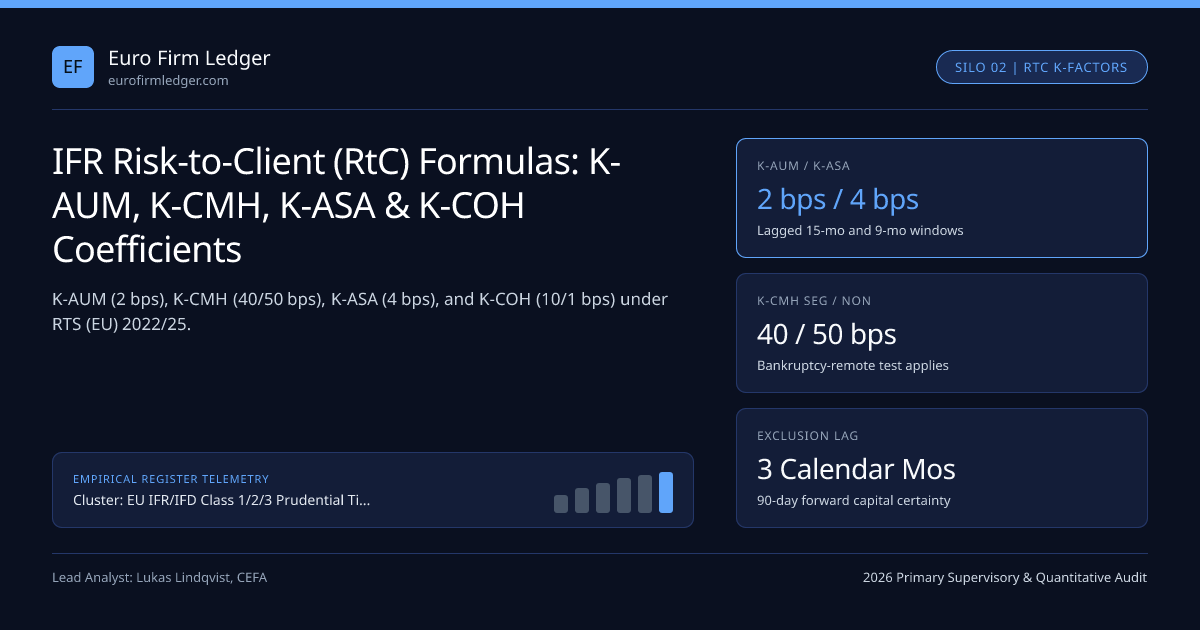
IFR Articles 16-20 and RTS (EU) 2022/25 quantify operational harm to clients via four lagged rolling-average K-factors: K-AUM, K-CMH, K-ASA, and K-COH.
Within Pillar 1 of Regulation (EU) 2019/2033, Risk-to-Client (RtC)—governed by IFR Articles 16 through 20 and Commission Delegated Regulation (EU) 2022/25—is the core capital driver for European asset managers, neo-brokers, retail CFD custodians, and agency execution desks. Rather than penalizing a firm's own balance sheet, RtC prices the potential restitution cost to clients if software bugs, mis-execution, faulty portfolio rebalancing, or sub-custodian reconciliation errors corrupt client portfolios or cash balances across four additive components: K-AUM + K-CMH + K-ASA + K-COH.
Within our EU IFR/IFD prudential capital guide and the IFR/IFD prudential hub, engineering accurate daily/monthly SQL data pipelines for RtC requires mastering three non-obvious mechanics in RTS (EU) 2022/25: 3-month exclusion lags, segregated vs non-segregated K-CMH definitions, and mutual exclusivity between K-AUM, K-COH, and K-DTF on the same trade.
Exact Coefficients, Observation Windows & Exclusion Lags (IFR Arts. 15–20)#
Every RtC K-factor discards the most recent 3 calendar months so CFOs know next month's exact RtC capital requirement 90 days in advance without pro-cyclical market-crash shocks:
| RtC K-Factor | IFR Art. | Statutory Scalar(s) | Rolling Observation Window | Critical RTS (EU) 2022/25 Scope Rule |
|---|---|---|---|---|
| K-AUM (Assets Under Management) | Art. 17 | 0.02% (2 bps) | Month-end values over prior 15 months, excluding 3 most recent (avg of 12 mos) | Includes discretionary PM + ongoing advice; excludes mandates formally delegated in from another financial entity (e.g., UCITS ManCo) |
| K-CMH (Client Money Held) | Art. 18 | 0.40% (segregated)<br>0.50% (non-segregated) | Daily end-of-day balances over prior 9 months, excluding 3 most recent (avg of 6 mos) | "Segregated" requires strict IFR Art. 4(1)(49) bankruptcy-remote national legal protection |
| K-ASA (Assets Safeguarded & Administered) | Art. 19 | 0.04% (4 bps) | Daily end-of-day fair values over prior 9 months, excluding 3 most recent (avg of 6 mos) | Applies regardless of whether safekeeping is performed in-house or delegated to a third-party sub-custodian! |
| K-COH (Client Orders Handled) | Art. 20 | 0.10% (cash trades)<br>0.01% (derivatives) | Daily gross order values over prior 6 months, excluding 3 most recent (avg of 3 mos) | Strictly agency RTO/execution; excludes orders generated under K-AUM portfolio management OR executed in firm's own name (K-DTF) |
Three High-Impact Technical Rules in Delegated Regulation (EU) 2022/25#
- UCITS / AIFM Inbound Delegation Exemption vs Outbound Inclusion (IFR Art. 17(2)): When a Luxembourg UCITS Management Company supervised by CSSF delegates portfolio management of a EUR 2 billion equity fund to a Paris MiFID firm supervised by AMF, the UCITS ManCo already holds capital on that fund under the UCITS Directive; therefore, IFR Article 17(2) exempts the MiFID delegate from K-AUM on that EUR 2B pool! Conversely, if the MiFID firm contracts directly with a pension client and delegates sub-management out to a US adviser, the MiFID firm must keep 100% of that portfolio inside K-AUM.
- When "Segregated" Client Cash Fails the 0.40% Test (IFR Art. 4(1)(49)): Holding client money in a separate bank account at Algemene Bank Nederland or UniCredit Bank Austria labeled "Client Account" is not enough for the 0.40% segregated K-CMH rate if the bank sits in a third country whose insolvency law does not guarantee statutory ring-fencing in bankruptcy—forcing the 0.50% non-segregated surcharge (+25% higher capital!).
- K-COH vs K-DTF Execution Boundary: If neo-brokers like Change or CAPEX.com route a client stock order purely as agent in the client's name, it enters K-COH (0.10% of daily average). If the broker executes in its own name (even riskless matched-principal), IFR Article 20(2) removes it from K-COH and places it into K-DTF instead.
Worked Multi-Asset Neo-Broker RtC Aggregation Formula#
Combining all four lagged rolling windows yields deterministic quarterly Risk-to-Client own-funds demand.
Custody vs Cash Domination Across Retail Neo-Broker Books#
- (0.0002 * AUM12Mlag3)
- + (0.0040 * CMHseg6Mlag3 + 0.0050 * CMHnonseg6Mlag3)
- + (0.0004 * ASA6Mlag3)
- + (0.0010 * COHcash3Mlag3 + 0.0001 * COHderiv3Mlag3)
- Where:
- AUM12Mlag3 = Arithmetic mean of month-end AUM for months [t-14 .. t-3]
- CMHseg6M_lag3 = Arithmetic mean of daily EOD bankruptcy-remote client cash for months [t-8 .. t-3]
- ASA6Mlag3 = Arithmetic mean of daily EOD fair value of safeguarded securities for months [t-8 .. t-3]
- COHcash3M_lag3 = Mean daily gross value of agency cash orders (Total 3-mo value / business days in [t-5 .. t-3])
- COHderiv3M_lag3 = Mean daily notional of agency derivative orders across business days in [t-5 .. t-3]
- Worked Retail Multi-Asset Neo-Broker RtC Calculation:
- AUM (robo-advisory portfolios, 12M lagged mean) = EUR 1,600,000,000 -> K_AUM = EUR 320,000
- CMHseg (EU credit-institution escrow) = EUR 95,000,000; CMHnonseg (non-EEA EMI float) = EUR 12,000,000
- > K_CMH = (0.0040 * 95M) + (0.0050 * 12M) = 380,000 + 60,000 = EUR 440,000
- ASA (omnibus ETFs & equities at Clearstream) = EUR 3,100,000,000 -> K_ASA = 0.0004 * 3.1B = EUR 1,240,000
- COHcash (daily avg excl. robo-PM orders) = EUR 42,000,000/day; COHderiv = EUR 180,000,000/day
- > K_COH = (0.0010 * 42M) + (0.0001 * 180M) = 42,000 + 18,000 = EUR 60,000
- Total RtC_EUR = 320,000 + 440,000 + 1,240,000 + 60,000 = EUR 2,060,000
Duration Adjustment for Interest-Rate Derivatives & Tied-Agent Attribution#
Two final precision adjustments in RTS (EU) 2022/25 prevent over- or under-stating K-COH: first, under IFR Article 20(2), notional values of interest-rate derivatives are adjusted for time to maturity (in years) divided by 10—meaning a 2-year Euribor swap carries only 2 / 10 = 20% of its raw notional in K-COH, whereas a 30-year Bund swap carries 30 / 10 = 300%. Second, under RTS (EU) 2022/25 Articles 1–2, all AUM advised and all client orders received through MiFID II Article 29 tied agents must be aggregated 100% into the principal firm's K-AUM and K-COH.
Frequently asked questions
How do newly licensed investment firms with fewer than 15 or 9 months of history calculate K-AUM and K-CMH?
Under IFR Articles 17(1), 18(1), 19(1), and 20(1) final subparagraphs, firms operating for shorter than the statutory observation window use historical data for all completed months from Day 1 plus business-plan projections, switching to the lagged rolling average as soon as the window fills.
Are negative-valued liability derivatives subtracted from client portfolio market value when computing K-AUM?
Under RTS (EU) 2022/25 Article 5, AUM is measured at fair value of total financial instruments including cash; where a portfolio contains leveraged or negative derivative positions, negative values offset positive asset values within that specific client portfolio, floored at zero per client.
Does placing client cash into a Qualifying Money Market Fund (QMMF) fell under K-CMH or K-ASA?
Under EBA Q&A and MiFID II Delegated Directive 2017/593 Article 4, once client funds are legitimately invested in QMMF units held under custody safeguarding rules rather than held as cash on bank accounts, the QMMF units are financial instruments captured under K-ASA (0.04%) rather than K-CMH (0.40%).
Does K-COH count unexecuted limit orders that expire or get cancelled at the close of trading?
For execution of orders on behalf of clients (A2), RTS (EU) 2022/25 measures executed trades; for reception and transmission of orders (A1), it measures orders actually transmitted to an executing broker or venue, excluding unrouted client drafts cancelled prior to transmission.
Publication record
- Published
- 14 November 2026
- Updated
- 14 November 2026
- Author
- Lukas Lindqvist, CEFA
- Review
- Review not recorded
- Automated fact check
- Passed in the stored pipeline record
- Source URLs
- 3 recorded
AI assistance recorded: anthropic/claude-opus-4.6. This field does not establish human review or source verification.
Academic & Institutional Attribution
Cite This Research & Embed Live Data Card
Standard academic & institutional research paper citation format.
Lukas Lindqvist, CEFA. (2026, November 14). IFR Risk-to-Client (RtC) Formulas: K-AUM, K-CMH, K-ASA & K-COH Coefficients. Euro Firm Ledger. https://eurofirmledger.com/bulletins/ifr-rtc-k-aum-k-cmh-k-asa-k-coh-client-risk-coefficientsRelated EU Ifr Ifd Class2 Kfactor Prudential & Institutional Briefings
Explore EU Ifr Ifd Class2 Kfactor Prudential Hub (20) →EU Ifr Ifd Class2 Kfactor Prudential
EU IFR & IFD Prudential Capital Guide: Class 1, 2 & 3 Tiers, PMR & K-FactorsEU Ifr Ifd Class2 Kfactor Prudential
IFR Risk-to-Market (RtM): K-NPR CRR Standardized Rules vs K-CMG 1.3x Clearing MarginEU Ifr Ifd Class2 Kfactor Prudential
IFR Trading Counterparty Default (K-TCD): 1.2 Alpha, Potential Future Exposure & CVAEU Ifr Ifd Class2 Kfactor Prudential
IFR Daily Trading Flow (K-DTF): Principal Execution Risk & RTS 2022/26 Stress ScalarsEU Ifr Ifd Class2 Kfactor Prudential
IFR Part Four Concentration Risk (K-CON): 25% Own-Funds Limit & 200%–900% MultipliersEU Ifr Ifd Class2 Kfactor Prudential
IFR Article 9 Own-Funds Composition: 56% CET1, 75% Tier 1 & CRR Deduction RulesEU Ifr Ifd Class2 Kfactor Prudential
IFR Article 43 Liquid Assets Requirement: One-Third FOR, HQLA Haircuts & Cash RulesEU Ifr Ifd Class2 Kfactor Prudential
IFR Articles 7 & 8 Investment Firm Groups: Prudential Consolidation vs Group Capital TestBafin Wplg Amf Consob Cnmv Supervision
Spain CNMV July 2023 CFD Intervention: Total Retail Ad, Affiliate & Sponsorship BanBafin Wplg Amf Consob Cnmv Supervision
Spain CNMV Circular 1/2022 & Complex Product Handwritten Risk Warnings GuideBafin Wplg Amf Consob Cnmv Supervision
Italy CONSOB Article 7-octies TUF & Decreto Crescita: ISP Website Blackout PowersBafin Wplg Amf Consob Cnmv Supervision
Italy SIM Licensing (Article 19 TUF): CONSOB & Banca d’Italia Twin-Peaks Supervision
Euro Firm Ledger Data, Benchmarks & Contributor Records
CC BY 4.0 Open Data
Open Institutional Datasets (CSV / JSON) →
Download desk-compiled quantitative series & schemas.
2026 Reference Matrix
2026 Institutional Benchmarks & Thresholds →
Statutory capital, clearing, margin & rate conventions.
Editorial Records
Authors & Review Records →
View named contributors where those records are available.
Complete Index
Master Research & Dossier Archive →
Browse all published briefings by topic pillar & date.