
EU Ifr Ifd Class2 Kfactor Prudential
IFR Daily Trading Flow (K-DTF): Principal Execution Risk & RTS 2022/26 Stress Scalars
IFR Article 33 charges 0.10% on principal cash trades and 0.01% on derivative notional under K-DTF, while RTS (EU) 2022/26 scales those coefficients downward during extreme exchange-wide volatility spikes.
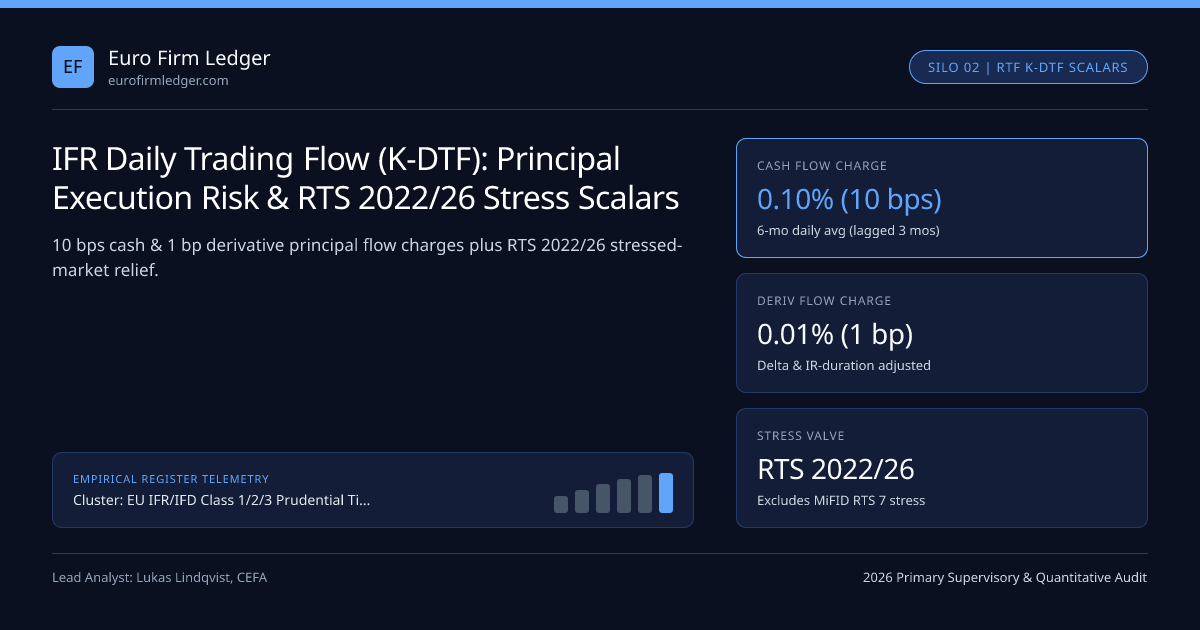
Algorithmic liquidity providers, Systematic Internalisers, and matched-principal brokers execute billions of euros of intraday turnover while ending the trading day nearly flat—meaning end-of-day balance-sheet metrics alone would miss the catastrophic operational risk of a fat-finger loop or runaway quote engine (such as the classic Knight Capital event). Article 33 of Regulation (EU) 2019/2033 (IFR) plugs that gap via Daily Trading Flow (K-DTF) inside Risk-to-Firm (RtF): charging 0.10% (10 bps) of average daily principal cash-trade value and 0.01% (1 bp) of average daily principal derivative notional, tempered by an innovative anti-procyclicality valve in Commission Delegated Regulation (EU) 2022/26 that reduces K-DTF coefficients during extreme market-wide volatility so market makers do not pull quotes when European bourses need liquidity most!
Within our EU IFR/IFD prudential capital guide and the IFR/IFD prudential hub, K-DTF directly shapes the economics of Amsterdam HFT desks under the AFM RTS 6 algorithmic framework as well as principal CFD and prime-brokerage venues like B2Prime, Colmex Pro, and CAPEX.com.
Scope Boundary: K-DTF (Principal / Own Name) vs K-COH (Pure Agency)#
Under IFR Articles 4(1)(33) and 33, K-DTF captures two categories of trades measured across each business day over the preceding 9 months, excluding the 3 most recent months (a 6-month lagged daily average):
- Dealing on Own Account (Annex I Section A3): Every proprietary buy/sell fill, market-making quote hit, B-book client CFD trade, and A-book LP hedge leg executed for the firm's own book; AND
- Client Orders Executed in the Firm's Own Name: Riskless matched-principal fills or commissionaire agency trades where the investment firm steps onto the exchange ticket in its own legal name (which IFR Article 20(2) simultaneously removes from K-COH to prevent double charging).
Contrast Table: How Trade Structures Map Across K-COH, K-DTF, K-NPR & K-TCD#
| Execution / Booking Model | Enters K-COH? | Enters K-DTF? | Enters K-NPR / K-CMG? | Enters K-TCD? |
|---|---|---|---|---|
| Pure Agency RTO / Disclosed Client Name | Yes (0.10% / 0.01%) | No | No | No |
| Matched-Principal / Undisclosed Own-Name Agency | No (excluded by Art. 20(2)) | Yes (Both Legs / Client Flow) | EUR 0 EOD net delta | Yes (if OTC non-cleared) |
| Unhedged Internal B-Book Retail CFD | No | Yes (1x Client Fill) | Yes (Full Net K-NPR) | Yes (residual client EV) |
| 100% Back-to-Back A-Book Principal CFD + LP Hedge | No | Yes (Client Leg + LP Hedge Leg!) | EUR 0 EOD net delta | Yes (LP + Client EV) |
| Eurex / Euronext HFT Options Market Making | No | Yes (Every Exchange Fill) | Yes (K-CMG or K-NPR) | No (QCCP exempt Art. 25(2)) |
Anti-Procyclical Stress Scalar Math in Delegated Regulation (EU) 2022/26#
During March 2020 COVID-19 or sovereign energy-shock sessions, daily exchange volumes triple precisely when spreads widen. If K-DTF applied a rigid 0.10% / 0.01% scalar to crisis-inflated volumes, market makers would suffer punitive Pillar 1 capital spikes three months later—incentivizing them to switch off quoting engines during crashes. To prevent liquidity evaporation, IFR Article 33(3)–(4) and RTS (EU) 2022/26 adjust the K-DTF coefficient (C_adj) downward whenever EU trading venues declare "stressed market conditions" under MiFID II RTS 7 (Commission Delegated Regulation (EU) 2017/578 Article 6(2))!
- KDTFEUR = (Ccashadj * DTFcashdailyavg) + (Cderivadj * DTFderivdailyavg)
- Ccashadj = 0.0010 * (DTFexclstresscash / DTFtotal_cash)
- Cderivadj = 0.0001 * (DTFexclstressderiv / DTFtotal_deriv)
- Note: Substituting Cadj * DTFtotal algebraically simplifies to applying the standard
- 0.10% / 0.01% scalar strictly to non-stressed flow (excluding RTS 7 stressed windows)
- normalized across total business days in the [t-8 .. t-3] window!
- Worked Amsterdam Cash-Equity & EURO STOXX Futures Principal Desk:
- Observation Window: 126 trading days across months [t-8 .. t-3]
- Total Principal Cash Equity Turnover = EUR 37,800,000,000 -> DTFtotalcash = EUR 300,000,000 / day
- Of which EUR 5,040,000,000 executed inside Euronext/Xetra RTS 7 Stressed Market Condition windows
- > DTFexclstress_cash = (37.80B - 5.04B) / 126 = EUR 260,000,000 / day
- > Ccashadj = 0.0010 * (260M / 300M) = 0.08667% -> Cash K_DTF = EUR 260,000
- Duration-Adjusted Futures Notional (excl. stress) = EUR 4,200,000,000 / day -> Deriv K_DTF = EUR 420,000
- Total Adjusted KDTFEUR = 260,000 + 420,000 = EUR 680,000 (saving EUR 40,000 on cash stress quotes)
Worked Amsterdam Principal Cash & Futures Desk Stress Relief#
Excluding venue-flagged stressed trading windows prevents crisis market-making from inflating subsequent quarterly COREP requirements.
Double-Legging Trap in Back-to-Back Principal CFD Hedging#
Notice a crucial operational detail in RTS (EU) 2022/25 for principal STP CFD brokers supervised by CySEC or BaFin: when a broker deals as principal against a retail client on EUR 1,000,000 of EUR/USD CFD and simultaneously executes a EUR 1,000,000 offsetting principal hedge leg with an institutional Liquidity Provider, both principal executions represent own-account trades of the firm—entering DTF at EUR 2,000,000 daily derivative flow (EUR 200/day K-DTF impact), whereas pure agency RTO (K-COH) counts the single EUR 1,000,000 client order once alongside K-NPR vs K-CMG position risk models.
Frequently asked questions
How does an algorithmic trading firm prove an hour qualified for the RTS (EU) 2022/26 stressed market discount?
RTS (EU) 2022/26 ties stressed market conditions strictly to official real-time or post-trade notifications published by the relevant EU trading venue under Article 6(2) of Commission Delegated Regulation (EU) 2017/578 (RTS 7)—firms cannot self-declare stress internally on OTC venues.
Are overnight securities financing transactions (repos and stock borrows) included in K-DTF?
Under RTS (EU) 2022/25 on K-factor measurement methods, financing transactions executed purely for treasury funding or collateral management rather than cash/derivative market trading are excluded from DTF while remaining captured under K-TCD.
How are options valued for K-DTF—by option premium paid or by underlying strike/delta notional?
Under IFR Article 33(2) and RTS (EU) 2022/25, derivative notional for options uses the delta-equivalent economic notional of the underlying instrument rather than just the small upfront option premium, preventing deep out-of-the-money options from inflating or hiding risk.
Does exercising or cash-settling an expiring futures contract at maturity count as a second K-DTF trade?
Automated expiry cash settlement by an exchange clearing house without a new order-book execution does not constitute a new daily trading flow transaction; only active execution fills entered into the market count.
Publication record
- Published
- 14 November 2026
- Updated
- 14 November 2026
- Author
- Lukas Lindqvist, CEFA
- Review
- Review not recorded
- Automated fact check
- Passed in the stored pipeline record
- Source URLs
- 4 recorded
AI assistance recorded: anthropic/claude-opus-4.6. This field does not establish human review or source verification.
Academic & Institutional Attribution
Cite This Research & Embed Live Data Card
Standard academic & institutional research paper citation format.
Lukas Lindqvist, CEFA. (2026, November 14). IFR Daily Trading Flow (K-DTF): Principal Execution Risk & RTS 2022/26 Stress Scalars. Euro Firm Ledger. https://eurofirmledger.com/bulletins/ifr-k-dtf-daily-trading-flow-principal-execution-stress-scalarRelated EU Ifr Ifd Class2 Kfactor Prudential & Institutional Briefings
Explore EU Ifr Ifd Class2 Kfactor Prudential Hub (20) →EU Ifr Ifd Class2 Kfactor Prudential
EU IFR & IFD Prudential Capital Guide: Class 1, 2 & 3 Tiers, PMR & K-FactorsEU Ifr Ifd Class2 Kfactor Prudential
IFR Part Four Concentration Risk (K-CON): 25% Own-Funds Limit & 200%–900% MultipliersEU Ifr Ifd Class2 Kfactor Prudential
IFR Article 9 Own-Funds Composition: 56% CET1, 75% Tier 1 & CRR Deduction RulesEU Ifr Ifd Class2 Kfactor Prudential
IFR Article 43 Liquid Assets Requirement: One-Third FOR, HQLA Haircuts & Cash RulesEU Ifr Ifd Class2 Kfactor Prudential
IFR Articles 7 & 8 Investment Firm Groups: Prudential Consolidation vs Group Capital TestEU Ifr Ifd Class2 Kfactor Prudential
IFD Article 24 ICARA Process: Internal Harm-Matrix Capital, Stress Testing & Wind-Down PlansEU Ifr Ifd Class2 Kfactor Prudential
IFD Articles 36–40 SREP & Pillar 2R Add-Ons: EBA/ESMA Joint Guidelines ExplainedEU Ifr Ifd Class2 Kfactor Prudential
IFD Articles 30–32 Remuneration Rules: No Bonus Cap, 40% Deferral & MRT ThresholdsBafin Wplg Amf Consob Cnmv Supervision
Italy SIM Licensing (Article 19 TUF): CONSOB & Banca d’Italia Twin-Peaks SupervisionBafin Wplg Amf Consob Cnmv Supervision
Netherlands AFM Turbos Leverage Intervention & RTS 6 Algorithmic Trading SupervisionBafin Wplg Amf Consob Cnmv Supervision
Belgium FSMA 2016 Royal Decree: Europe’s Complete OTC Retail CFD Distribution BanBafin Wplg Amf Consob Cnmv Supervision
Poland KNF “Experienced Retail Client” CFD Tier (40:1 Leverage) & Training Rules
Euro Firm Ledger Data, Benchmarks & Contributor Records
CC BY 4.0 Open Data
Open Institutional Datasets (CSV / JSON) →
Download desk-compiled quantitative series & schemas.
2026 Reference Matrix
2026 Institutional Benchmarks & Thresholds →
Statutory capital, clearing, margin & rate conventions.
Editorial Records
Authors & Review Records →
View named contributors where those records are available.
Complete Index
Master Research & Dossier Archive →
Browse all published briefings by topic pillar & date.