
EU Ifr Ifd Class2 Kfactor Prudential
IFR Article 12 Class 3 SNI Thresholds: All 10 Quantitative Tests & Transition Lags
IFR Article 12 grants Class 3 Small and Non-Interconnected (SNI) status only to EEA investment firms meeting ten simultaneous caps—including zero client money, zero custody, and zero trading risk.
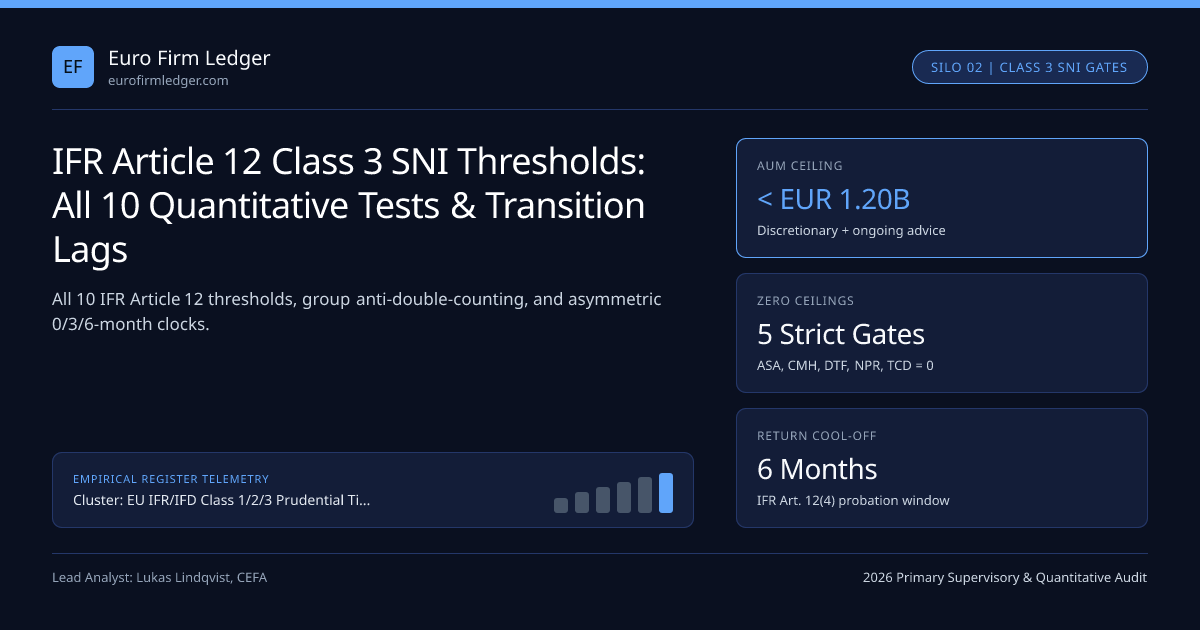
Achieving Class 3 Small and Non-Interconnected (SNI) classification under Article 12(1) of Regulation (EU) 2019/2033 (IFR) unlocks dramatic regulatory relief for European wealth advisers, family-office portfolio managers, and corporate finance introducers: complete exemption from K-factor capital math, exemption from IFD Article 32 bonus deferral and equity payout rules, exemption from public Pillar 3 disclosures, and annual (rather than quarterly) COREP IF supervisory filings. Yet Article 12 is engineered as an all-or-nothing 10-gate lock—breaching even a single EUR 0 or volume ceiling (measured across the entire consolidated group!) strips SNI status and catapults the firm into Class 2.
Within our EU IFR/IFD prudential capital guide and the IFR/IFD prudential hub, subtle aggregation errors under IFR Article 12(2)—especially counting shared intra-group investment advisory AUM twice or forgetting that holding EUR 1 of transient client fee escrow violates CMH = 0—are the #1 cause of unexpected supervisory reclassifications during BaFin, CSSF, and AMF desk audits.
All 10 Mandatory Quantitative Gates Under IFR Article 12(1)#
Every investment firm claiming Class 3 SNI treatment (Kleine Wertpapierinstitute under § 2(16) WpIG in Germany) must continuously verify compliance with all nine numerical metrics in Article 12(1)(a)–(i) plus absence of dealing permissions:
| IFR Art. 12 Gate | Statutory Metric | Exact Class 3 Ceiling | Measurement Basis & Group Aggregation Rule (Art. 12(2)) |
|---|---|---|---|
| 12(1)(a) AUM | Assets Under Management (discretionary PM + ongoing non-discretionary advice) | < EUR 1.2 billion | 15-month rolling avg excl. last 3 mos; aggregated across group (excl. intra-group overlap) |
| 12(1)(b) COH (Cash) | Client Orders Handled in cash trades (RTO + agency execution) | < EUR 100 million / day | 6-month rolling avg excl. last 3 mos; aggregated across group |
| 12(1)(b) COH (Deriv) | Client Orders Handled in derivatives (notional value) | < EUR 1.0 billion / day | 6-month rolling avg excl. last 3 mos; aggregated across group |
| 12(1)(c) ASA | Assets Safeguarded and Administered | = EUR 0 (Absolute Zero) | Instantaneous disqualification upon holding any client securities |
| 12(1)(d) CMH | Client Money Held (whether segregated or non-segregated) | = EUR 0 (Absolute Zero) | Instantaneous disqualification upon holding any client cash |
| 12(1)(e) DTF | Daily Trading Flow (own-account or matched-principal execution) | = EUR 0 (Absolute Zero) | Instantaneous disqualification upon executing any principal flow |
| 12(1)(f) NPR / CMG | Net Position Risk or Clearing Margin Given on trading book | = EUR 0 (Absolute Zero) | Zero trading-book positions permitted (non-trading FX/cash hedge allowed) |
| 12(1)(g) TCD | Trading Counterparty Default exposure | = EUR 0 (Absolute Zero) | Zero OTC derivative trading-book counterparty exposure |
| 12(1)(h) Balance Sheet | On- and off-balance-sheet total of the investment firm | < EUR 100 million | Combined across all group investment firms |
| 12(1)(i) Gross Revenue | Total annual gross revenue from investment services & activities | < EUR 30 million | Combined across group investment firms (prior financial year) |
Crucial Asymmetric Transition Clocks Under IFR Article 12(3) and 12(4)#
Compliance officers frequently misread how fast Class 3 privileges vanish when a growing wealth boutique crosses a threshold:
- Immediate Loss of SNI Status (0-Day Lag): Under IFR Article 12(3) first subparagraph, if a firm breaches any of the five EUR 0 gates (ASA, CMH, DTF, NPR, TCD) or breaches the EUR 100M balance-sheet or EUR 30M gross-revenue ceilings, it ceases to be a Class 3 SNI firm immediately—activating quarterly COREP IF reporting, full ICARA granularity, and IFD remuneration governance.
- 3-Month Lag on AUM & COH Growth: Under IFR Article 12(3) second subparagraph, if the firm breaches only the EUR 1.2 billion AUM gate or the EUR 100M/EUR 1B COH gates (which already incorporate a 3-month calculation lag), it remains Class 3 for 3 additional months from the date the threshold was exceeded, giving management a structured quarter to upgrade XBRL reporting and governance committees.
- 6-Month Probation to Re-Enter Class 3: Under IFR Article 12(4), a Class 2 firm whose metrics shrink below all Article 12(1) thresholds regains Class 3 status only after remaining continuously below every threshold for 6 consecutive months AND formally notifying its home NCA without supervisory objection.
Non-Trading Book Treasury Exception vs Prohibited NPR#
Does investing a Class 3 advisory boutique's own corporate EUR 300,000 retained earnings in a short-term German Bund ETF or holding a USD corporate bank account to pay software vendors violate NPR = 0? No—IFR Article 12(1)(f) and EBA Q&A clarify that NPR = 0 applies strictly to trading-book positions held with trading intent; non-trading-book treasury management of own corporate funds (or hedging non-trading FX fee receivables) does not trigger K-NPR, whereas executing principal broker-dealer trades like CAPEX.com, 1Market, or Aktien AG immediately triggers Class 2.
- IsClass3 = (AUMgrp < 1.2e9) AND (COHcashgrp < 1.0e8) AND (COHderiv_grp < 1.0e9)
- AND (ASA == 0) AND (CMH == 0) AND (DTF == 0) AND (NPR == 0) AND (TCD == 0)
- AND (BSgrp < 1.0e8) AND (GrossRevgrp < 3.0e7)
- OFRClass3EUR = max(PMR75kor150k, 0.25 * NetFixedOverheadsEUR)
- ComplianceCostJumpUponBreachingEUR12BAUM (AnnualGovernanceDelta):
- DeltaCapitalEUR = max(0, (0.0002 * AUMavg + KCOH) - max(75000, FOR))
- AnnualClass2Overhead = CquarterlyXBRL + CPillar3audit + CMRTremuneration_counsel
- Worked Luxembourg / Munich Multi-Family Office Crossing EUR 1.35B AUM:
- PMR = EUR 75,000; Net Fixed Overheads = EUR 1,800,000 -> FOR = EUR 450,000
- KAUM at EUR 1.35B = 0.0002 * 1,350,000,000 = EUR 270,000; KCOH = EUR 18,000 -> KFR = EUR 288,000
- Binding Class 2 Pillar 1 OFR = max(75,000, 450,000, 288,000) = EUR 450,000 (Delta_Capital = EUR 0!)
- Note: Even though FOR (EUR 450k) still exceeds KFR (EUR 288k) up to EUR 2.25B AUM, breaching EUR 1.2B
- still triggers full Class 2 quarterly COREP, Pillar 3 disclosures, and IFD remuneration rules!
Governance Cliff vs K-AUM Crossover Modeling#
Because K-AUM charges just 2 basis points (EUR 240,000 at EUR 1.2 billion), fixed overheads usually stay binding long after Class 3 status is lost.
Group-Wide Double-Counting Relief Under IFR Article 12(2)#
When two sister boutiques inside the same European wealth group—say, a Paris discretionary manager regulated by AMF managing EUR 750 million and a Luxembourg investment adviser regulated by CSSF providing sub-advisory research on EUR 600 million of those exact same portfolios—aggregate their AUM under Article 12(2), raw addition (EUR 1.35B) would falsely breach EUR 1.2 billion. Fortunately, IFR Article 12(2) explicitly instructs groups to exclude any double counting when measuring consolidated AUM and COH, preserving Class 3 SNI eligibility at the true EUR 750 million unique client asset pool.
Frequently asked questions
Does one-off transactional investment advice count toward the EUR 1.2 billion Class 3 AUM threshold?
No. Under IFR Article 4(1)(27) and Article 17, AUM includes discretionary portfolio management plus non-discretionary arrangements constituting investment advice of an ongoing nature. Isolated, one-off investment recommendations without recurring portfolio monitoring are excluded from AUM.
Can an MTF operator that never trades on its own account qualify as a Class 3 SNI firm?
In theory, if an MTF holds zero client money/assets, executes zero matched-principal flow, and stays below EUR 100M cash / EUR 1B derivative COH, EUR 100M B/S, and EUR 30M revenue, Article 12 does not automatically bar A(8) MTF operation—though its PMR floor rises to EUR 150,000 under IFD Article 9(3).
Even if a firm becomes Class 2 by crossing EUR 1.2 billion AUM, does it automatically face 40% bonus deferrals?
Not necessarily. Under IFD Article 32(4)(a), a Class 2 firm remains exempt from mandatory variable-pay deferral and 50% instrument payout rules if its 4-year average on- and off-balance-sheet assets stay at or below EUR 100 million (or up to EUR 300M under national discretion).
Does holding a power of attorney to debit management fees from a client’s third-party custodian bank trigger CMH > 0?
Provided the fee mandate permits deducting only invoiced management fees directly into the firm’s corporate revenue account and does not enable the firm to transfer client cash to arbitrary third parties or hold unallocated client balances, most EEA NCAs do not classify fee-collection mandates as CMH.
Publication record
- Published
- 14 November 2026
- Updated
- 14 November 2026
- Author
- Lukas Lindqvist, CEFA
- Review
- Review not recorded
- Automated fact check
- Passed in the stored pipeline record
- Source URLs
- 4 recorded
AI assistance recorded: anthropic/claude-opus-4.6. This field does not establish human review or source verification.
Academic & Institutional Attribution
Cite This Research & Embed Live Data Card
Standard academic & institutional research paper citation format.
Lukas Lindqvist, CEFA. (2026, November 14). IFR Article 12 Class 3 SNI Thresholds: All 10 Quantitative Tests & Transition Lags. Euro Firm Ledger. https://eurofirmledger.com/bulletins/ifr-article-12-class-3-sni-small-non-interconnected-thresholdsRelated EU Ifr Ifd Class2 Kfactor Prudential & Institutional Briefings
Explore EU Ifr Ifd Class2 Kfactor Prudential Hub (20) →EU Ifr Ifd Class2 Kfactor Prudential
EU IFR & IFD Prudential Capital Guide: Class 1, 2 & 3 Tiers, PMR & K-FactorsEU Ifr Ifd Class2 Kfactor Prudential
IFD Article 9 Initial & Permanent Minimum Capital: EUR 75k, 150k & 750k TiersEU Ifr Ifd Class2 Kfactor Prudential
IFR Article 13 Fixed Overheads Requirement (FOR) & RTS 2022/1455 DeductionsEU Ifr Ifd Class2 Kfactor Prudential
IFR Risk-to-Client (RtC) Formulas: K-AUM, K-CMH, K-ASA & K-COH CoefficientsEU Ifr Ifd Class2 Kfactor Prudential
IFR Risk-to-Market (RtM): K-NPR CRR Standardized Rules vs K-CMG 1.3x Clearing MarginEU Ifr Ifd Class2 Kfactor Prudential
IFR Trading Counterparty Default (K-TCD): 1.2 Alpha, Potential Future Exposure & CVAEU Ifr Ifd Class2 Kfactor Prudential
IFR Daily Trading Flow (K-DTF): Principal Execution Risk & RTS 2022/26 Stress ScalarsEU Ifr Ifd Class2 Kfactor Prudential
IFR Part Four Concentration Risk (K-CON): 25% Own-Funds Limit & 200%–900% MultipliersBafin Wplg Amf Consob Cnmv Supervision
BaFin MaComp Circular (BT 3, BT 5 & BT 13): German Inducements, Cost Info & Target MarketsBafin Wplg Amf Consob Cnmv Supervision
France AMF Loi Sapin 2 (Article L. 533-12-7): Electronic Derivative Advertising BanBafin Wplg Amf Consob Cnmv Supervision
France ACPR & AMF Twin-Peaks Licensing: Entreprise d’Investissement (EI) vs SGP RulesBafin Wplg Amf Consob Cnmv Supervision
Spain CNMV July 2023 CFD Intervention: Total Retail Ad, Affiliate & Sponsorship Ban
Euro Firm Ledger Data, Benchmarks & Contributor Records
CC BY 4.0 Open Data
Open Institutional Datasets (CSV / JSON) →
Download desk-compiled quantitative series & schemas.
2026 Reference Matrix
2026 Institutional Benchmarks & Thresholds →
Statutory capital, clearing, margin & rate conventions.
Editorial Records
Authors & Review Records →
View named contributors where those records are available.
Complete Index
Master Research & Dossier Archive →
Browse all published briefings by topic pillar & date.