
Mifid2 Article34 35 Eea Passporting
MiFIR Article 26 & RTS 22: T+1 ARM Transaction Reporting for EEA Branches
Under MiFIR Article 26 and Delegated Regulation (EU) 2017/590 Article 14, EEA branches submit all 65-field T+1 transaction reports to their Home NCA, which routes records onward via ESMA TREM.
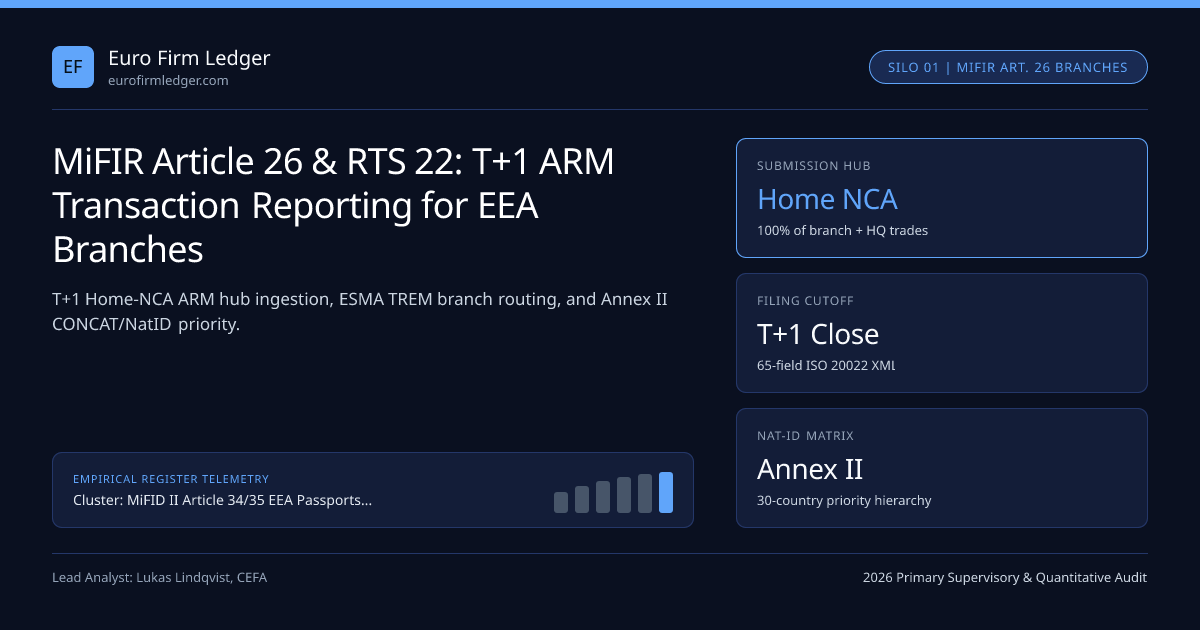
One of the sharpest operational traps in cross-border MiFID II compliance sits at the intersection of MiFID II Article 35(8) and Commission Delegated Regulation (EU) 2017/590 (RTS 22) Article 14: although Article 35(8) gives the host regulator supervisory authority over branch compliance with MiFIR Article 26, RTS 22 Article 14(1) mandates that an EEA investment firm submit 100% of its T+1 transaction reports—including every trade executed by its foreign EEA branches—exclusively to the Home National Competent Authority, never directly to the host regulator's portal!
Within our MiFID II EEA passporting cornerstone guide and the EEA passporting hub, misrouting branch XML files directly to a host supervisor or mispopulating RTS 22 branch-country ISO tags causes immediate Approved Reporting Mechanism (ARM) schema rejections and multi-hundred-thousand-euro back-reporting remediation orders from BaFin, AFM, and CSSF.
Hub-and-Spoke TREM Routing Under RTS 22 Article 14 and MiFIR Review Updates#
Prior to 2018, under MiFID I, EEA branches often submitted local equity reports directly to host authorities while sending derivatives elsewhere, producing massive duplicate and orphaned records. RTS 22 solved this by centralizing ingestion through the Home NCA + ESMA Transaction Reporting Exchange Mechanism (TREM):
- Single Submission Endpoint: An Austrian or Dutch dealer such as UniCredit Bank Austria or Algemene Bank Nederland transmits a single consolidated ISO 20022 auth.016 XML feed via its licensed ARM (e.g., MarketAxess Trax, UnaVista/LSEG, or Deutsche Borse REGIS-TR) to its home authority no later than the close of the following working day (T+1).
- Automated TREM Fan-Out: Using the two-letter ISO 3166-1 alpha-2 country codes populated in RTS 22 Fields 8, 16, 37, 46, and 58, the home NCA automatically forwards copies via ESMA TREM to (a) the NCA of the most relevant market in terms of liquidity (MRM), (b) the host NCA of any branch involved in client membership, supervision, or execution, and (c) the NCA supervising the executing trader.
Critical RTS 22 Branch Country Fields & Annex II Natural-Person Identifier Priority#
Passported firms onboarding retail savers across 25+ nationalities frequently suffer systemic rejections on two technical fronts: Branch Country Flagging and RTS 22 Annex II Natural-Person National Identifiers (where Spanish DNI/NIF, Italian Codice Fiscale, Polish PESEL, Estonian personal codes, and German CONCAT strings follow totally different priority hierarchies!).
| RTS 22 Field # | XML Field Name | Exact Rule for Cross-Border / Art. 35 Branch Trades | Top ESMA Validation Rejection Error |
|---|---|---|---|
| Field 7 / 16 | Buyer / Seller ID (LEI vs NatID / CONCAT) | Legal entities: 20-char GLEIF LEI; Natural persons: strictly follow nationality's 1st/2nd/3rd priority in RTS 22 Annex II | Using CONCAT (CC + YYYYMMDD + First5 + Last5) for an Italian or Spanish citizen whose 1st priority is Codice Fiscale / NIF! |
| Field 16 / 25 | Country of Branch for the Buyer / Seller | Populate ISO code of branch whose client membership agreement governs the relationship | Leaving blank or entering client residence ISO instead of branch establishment ISO |
| Field 37 | Country of Branch Membership | ISO country code of the branch that received the order from the client or made the client investment decision | Mismatching remote Article 34 orders (must use Home country ISO, never client country!) |
| Field 46 / 58 | Country of Branch Supervising Trader / Decision Maker | ISO country where the trader/algorithm (Field 59) is organizationally supervised—even if travelling temporarily | Omitting country tag when a Paris branch trader executes on head-office Xetra membership |
Modeling Back-Reporting Remediation Cost Under MiFIR Article 26 Audits#
When an NCA data-quality audit (such as BaFin's § 9 WpHG / Art. 26 special inspection or CySEC's TRS data sweep) discovers a systematic CONCAT or Branch-Country bug spanning 24 months of cross-border CFD or equity flow at firms like CAPEX.com or B2Prime, the firm cannot simply patch forward; it must cancel (CANC) and replay (NEWT) every defective historical XML record.
- (Nmonthsaffected * Vmonthlytx * Rerrorpct) * Feearmcancel_newt
- + Cforensicetl_engineering
- + FineNCAdata_quality
- Where:
- Nmonthsaffected = Historical months containing systematic RTS 22 Annex II / Field 37 error
- Vmonthlytx = Monthly reportable executions across C1-C11 instruments & OTC derivatives
- Rerrorpct = Share of cross-border records failing Annex II NatID or branch-flag audit
- Feearmcancel_newt = ARM per-record surcharge for historical CANC + NEWT pair (EUR)
- Cforensicetl_engineering = External RegTech reconciliation & XML replay engineering cost (EUR)
- FineNCAdata_quality = Administrative penalty under MiFID II Art. 70 for Art. 26 reporting failures (EUR)
- Worked 24-Month Cross-Border Natural-Person Identifier Replay Audit:
- Nmonthsaffected = 24, Vmonthlytx = 450,000 trades, Rerrorpct = 0.22 (2,376,000 bad records)
- Feearmcancel_newt = EUR 0.045 / pair (EUR 106,920 ARM replay bill)
- Cforensicetlengineering = EUR 165,000, FineNCAdataquality = EUR 280,000
- CremedEUR = 106,920 + 165,000 + 280,000 = EUR 551,920 total back-reporting & sanction cost
Daily ARM Rejection Reconciliation and NCA Completeness Sampling#
High-reliability cross-border brokers run automated T+1 reconciliation scripts comparing internal OMS execution ledgers against Approved Reporting Mechanism (ARM) ACK/NACK receipts and quarterly NCA feedback extracts—preventing silent systematic field omissions across foreign branch orders from compounding into multi-year enforcement fines.
Dual-Nationality Sorting (RTS 22 Article 6(2)) and Article 4 RTO Transmission Safe Harbour#
Two technical lifesavers protect cross-border operations: first, if a retail client holds dual EEA nationality (e.g., French FR and German DE), RTS 22 Article 6(2) dictates sorting the two ISO alpha-2 country codes alphabetically (DE precedes FR) and applying the first country's Annex II identifier (DE -> CONCAT)! Second, smaller EUR 75,000 Article 34 RTO brokers can avoid building an ARM pipeline only if they execute a formal RTS 22 Article 4 written transmission agreement shifting T+1 reporting onto their executing EEA broker—and periodically audit that executing broker's submissions alongside remote MTF venue rules.
Frequently asked questions
Should a Milan Article 35 branch of a German investment firm send its MiFIR Article 26 transaction reports to CONSOB or BaFin?
Exclusively to BaFin (its Home NCA) via the firm’s Approved Reporting Mechanism (ARM). Under RTS 22 Article 14(1), the single home-NCA report populates "IT" in the relevant branch-country fields (16, 37, 46, or 58), and BaFin automatically forwards the record to CONSOB via ESMA TREM.
What identifier do you report in Field 7 for an Italian retail client onboarded remotely under Article 34?
Under RTS 22 Annex II, Italy’s Priority 1 natural-person identifier is the Italian tax code (Codice Fiscale). Submitting a CONCAT string for an Italian citizen violates Annex II priority rules and triggers NCA data-quality remediation.
What is the "No LEI, No Trade" rule under MiFIR Article 26 and RTS 22 Article 13?
RTS 22 Article 13(2) requires an investment firm to obtain a valid 20-character ISO 17442 Legal Entity Identifier from any corporate, trust, or foundation client BEFORE providing a service that triggers transaction reporting—blocking trade execution if no LEI is supplied.
If a remote Article 34 firm serves clients living in France without a French branch, what goes in Field 37 (Country of Branch)?
If no Article 35 branch is involved, the firm populates its own Home Member State ISO country code—never the remote client’s country of residence—because remote cross-border services are legally executed from the head office.
Publication record
- Published
- 14 November 2026
- Updated
- 14 November 2026
- Author
- Lukas Lindqvist, CEFA
- Review
- Review not recorded
- Automated fact check
- Passed in the stored pipeline record
- Source URLs
- 3 recorded
AI assistance recorded: anthropic/claude-opus-4.6. This field does not establish human review or source verification.
Academic & Institutional Attribution
Cite This Research & Embed Live Data Card
Standard academic & institutional research paper citation format.
Lukas Lindqvist, CEFA. (2026, November 14). MiFIR Article 26 & RTS 22: T+1 ARM Transaction Reporting for EEA Branches. Euro Firm Ledger. https://eurofirmledger.com/bulletins/mifir-article-26-arm-passport-branch-transaction-reporting-t1Related Mifid2 Article34 35 Eea Passporting & Institutional Briefings
Explore Mifid2 Article34 35 Eea Passporting Hub (20) →Mifid2 Article34 35 Eea Passporting
MiFID II Article 34 & 35 EEA Passporting: Host NCA Powers & Reverse Solicitation GuideMifid2 Article34 35 Eea Passporting
MiCA Article 65 CASP Passport vs MiFID II Article 34: Article 60 Equivalence GuideMifid2 Article34 35 Eea Passporting
EU Retail Investment Strategy (RIS): MiFID II Article 34 Cross-Border KPIs & PlatformsMifid2 Article34 35 Eea Passporting
MiFID II Passport Withdrawal, Cross-Border Book Novation & Orderly Wind-DownMifid2 Article34 35 Eea Passporting
MiFID II Article 34 Cross-Border Notification SLA & Home NCA Primacy ExplainedMifid2 Article34 35 Eea Passporting
MiFID II Article 35 Branch Establishment & Host NCA Conduct Supervision SplitMifid2 Article34 35 Eea Passporting
MiFID II Article 86 Precautionary Powers: How Host NCAs Block Abusive PassportsMifid2 Article34 35 Eea Passporting
MiFID II Article 42 Reverse Solicitation: Exclusive Initiative & ESMA EnforcementEU Ifr Ifd Class2 Kfactor Prudential
EBA ITS 2021/2284 Supervisory Reporting: Quarterly COREP IF XBRL Templates & DeadlinesEU Ifr Ifd Class2 Kfactor Prudential
IFR Article 57 Transitional Relief Expiry (June 2026): Full Uncapped Capital Step-UpEU Ifr Ifd Class2 Kfactor Prudential
DORA ICT Operational Risk Inside IFD ICARA: Prudential Capital Modeling for Cyber EventsBafin Wplg Amf Consob Cnmv Supervision
Germany BaFin WpIG & Deutsche Bundesbank Dual Supervision: § 15 Licensing & Tiers
Euro Firm Ledger Data, Benchmarks & Contributor Records
CC BY 4.0 Open Data
Open Institutional Datasets (CSV / JSON) →
Download desk-compiled quantitative series & schemas.
2026 Reference Matrix
2026 Institutional Benchmarks & Thresholds →
Statutory capital, clearing, margin & rate conventions.
Editorial Records
Authors & Review Records →
View named contributors where those records are available.
Complete Index
Master Research & Dossier Archive →
Browse all published briefings by topic pillar & date.