
EU Ifr Ifd Class2 Kfactor Prudential
IFR Part Four Concentration Risk (K-CON): 25% Own-Funds Limit & 200%–900% Multipliers
IFR Part Four (Articles 36-42) caps trading-book exposure to any single counterparty group at 25% of regulatory own funds, imposing steep 200% to 900% K-CON multipliers on permitted short-term excesses.
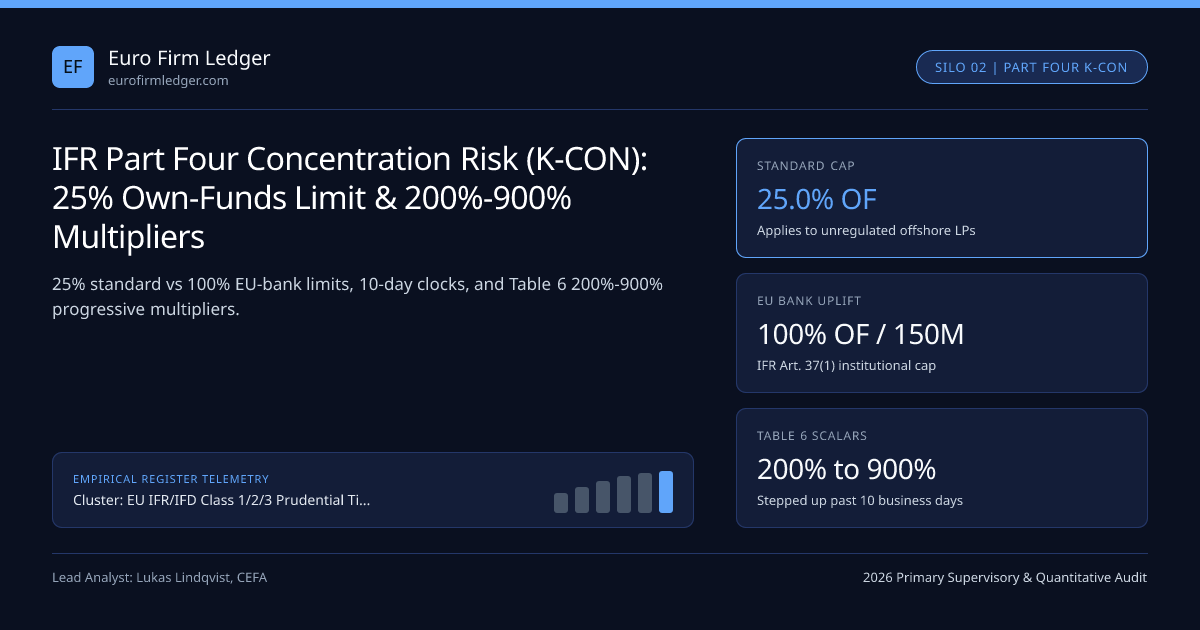
Single-counterparty concentration—most notoriously routing 100% of an STP broker's trading-book liquidity hedges to a single offshore parent or holding massive single-issuer inventory—has triggered more sudden European brokerage insolvencies than market volatility itself. Part Four of Regulation (EU) 2019/2033 (IFR Articles 36 through 42) polices trading-book concentration via a two-tier mechanism: a hard 25% of regulatory own funds limit per client or group of connected clients (up to EUR 150M / 100% of own funds for regulated banks and investment firms), paired with punitive 200% to 900% K-CON capital multipliers (IFR Article 39 Table 6) whenever a trading-book exposure exceeds that soft ceiling!
Within our EU IFR/IFD prudential capital guide and the IFR/IFD prudential hub, K-CON frequently shocks newly licensed Class 2 brokers at CySEC and BaFin whose EUR 1.5 million own-funds base yields a EUR 375,000 standard 25% limit—meaning a single un-regulated liquidity provider netting set with EUR 900,000 of K-TCD Exposure Value immediately breaches the statutory concentration cap!
Standard 25% Limit vs Regulated Bank / Investment-Firm EUR 150M Carve-Out#
IFR Article 37(1) sets two dramatically different Concentration Risk Limits (L) depending on whether the counterparty group consists of regulated financial institutions:
- General Corporate / Retail / Unregulated Offshore Counterparties: Limit + 'L = 25% of the firm's regulatory own funds' + . Crucially, an unregulated St. Vincent, Mauritius, or Seychelles group parent does NOT qualify for the institutional uplift and is capped strictly at 25%!
- Credit Institutions or EU/Equivalent Investment Firms: Limit L = max(25% of own funds, min(EUR 150,000,000, 100% of own funds))—meaning for any Class 2 broker with under EUR 150 million of own funds, hedging with regulated European banks (Algemene Bank Nederland, UniCredit Bank Austria) or EU Class 2 prime brokers (B2Prime) lifts the concentration limit fourfold from 25% to 100% of own funds (provided non-institution connected entities inside that group stay <= 25%)!
IFR Article 39 Table 6 Progressive Multiplier Schedule (<=10 Days vs >10 Days)#
Whenever trading-book Exposure Value (EV) exceeds the counterparty limit (L), the firm calculates the *Own Funds Requirement of the Excess (OFRE = (OFRpositionand_TCD / EV) EVe) and multiplies slices of OFRE by IFR Article 39(2) Table 6 factors—which jump sharply the instant an excess persists past 10 business days**!
| Excess Tranche (% of Own Funds) | Column A: Excess <= 10 Days | Column B: Excess > 10 Days | Hard Statutory Ceiling (IFR Art. 37(2)) |
|---|---|---|---|
| Up to 40% of Own Funds | 200% (2.0x base charge) | 300% (3.0x base charge) | Immediate NCA breach notification required under Art. 38(1) |
| From 40% to 60% of Own Funds | 300% (3.0x base charge) | 400% (4.0x base charge) | Must diversify across multiple prime LPs or inject CET1 |
| From 60% to 80% of Own Funds | 400% (4.0x base charge) | 500% (5.0x base charge) | Sovereign AAA Eurozone debt exempt under IFR Art. 40(1) |
| From 80% to 100% of Own Funds | 500% (5.0x base charge) | 600% (6.0x base charge) | QCCP cleared exposures exempt under IFR Art. 40(1)(d) |
| From 100% to 250% of Own Funds | 600% (6.0x base charge) | 800% (8.0x base charge) | Single >10-day excess strictly barred above 500% of Own Funds |
| Over 250% of Own Funds | 900% (9.0x base charge) | 900% (9.0x base charge) | Aggregate of all >10-day excesses barred above 600% of Own Funds |
Non-Trading-Book Concentration Monitoring (IFR Art. 36(2) & ICARA)#
Notice a vital distinction: Pillar 1 K-CON applies strictly to trading-book exposures (issuer equity/bond positions + trading-book K-TCD). What about an investment firm parking 80% of its own corporate bank cash at a single commercial bank on the non-trading book? While non-trading cash deposits do not generate Pillar 1 K-CON multipliers, IFR Article 36(1) requires firms to monitor and report non-trading concentration quarterly in COREP IF (C 25.00 / IF 08) and hold Pillar 2 concentration capital inside IFD Article 24 ICARA.
Worked K-CON Penalty Math on an Over-Concentrated Offshore LP#
Watch how fast Table 6 destroys capital ratios when a broker with EUR 2,000,000 of regulatory own funds holds EUR 1,700,000 of trading-book K-TCD Exposure Value with an unregulated offshore sister LP for more than 10 days:
- EVe = max(0, EVcounterparty - LimitArt37)
- UnitOFRRate = BasePositionAndTCDOFR / EV_counterparty
- KCONEUR = Sum{tranche k in Table 6} [ UnitOFRRate * EVeslicek * MultiplierTable6(k, Duration_Days) ]
- Worked Offshore LP Excess Scenario (> 10 Business Days):
- Regulatory Own Funds (OF) = EUR 2,000,000
- Offshore Unregulated LP Limit (25% of OF) = EUR 500,000
- Actual K-TCD Exposure Value (EV) = EUR 1,700,000 -> Excess (EVe) = 1,700,000 - 500,000 = EUR 1,200,000 (60% of OF!)
- Base K-TCD Unit Rate (Offshore LP: 1.2 * 8% * 1.5) = 14.40% of EV
- Tranche 1 (0% to 40% of OF = first EUR 800,000 of EVe, >10d Col B = 300%):
- KCON1 = 0.1440 * 800,000 * 3.00 = EUR 345,600
- Tranche 2 (40% to 60% of OF = next EUR 400,000 of EVe, >10d Col B = 400%):
- KCON2 = 0.1440 * 400,000 * 4.00 = EUR 230,400
- Total K_CON Penalty = 345,600 + 230,400 = EUR 576,000 (ON TOP of EUR 244,800 base K-TCD = EUR 820,800 total!)
- Contrast With EU Regulated Bank LP: Limit = 100% of OF (EUR 2,000,000) -> EVe = EUR 0 -> K_CON = EUR 0!
Strict Prohibition on Artificial 10-Day Window-Dressing (IFR Article 42)#
Some rogue treasury desks historically tried to dodge Column B's steeper > 10 days multipliers by temporarily closing out an intragroup swap on Day 9 with a sister company and re-opening it on Day 10 to "reset the 10-day clock." IFR Article 42(1)–(2) explicitly outlaws temporary transfers of exposures to reset the 10-day period, requiring immediate supervisory notification and imposing the full >10-day multiplier backdated to Day 1.
Frequently asked questions
Are Class 3 Small and Non-Interconnected (SNI) firms subject to Part Four K-CON limits?
No, because Class 3 SNI firms under IFR Article 12 are prohibited from holding any trading-book positions (NPR = 0 and TCD = 0). However, they still monitor non-trading bank cash diversification under MiFID II safeguarding rules and ICARA.
How are connected counterparties grouped together when testing the 25% K-CON threshold?
IFR Article 4(1)(15) imports the CRR Article 4(1)(39) "group of connected clients" definition—aggregating all legal entities linked by parent-subsidiary control (>50% voting rights or dominant influence) OR economic interconnectedness where one entity’s failure would likely cause the others to default.
Do German Bunds or French OATs held on a bond market-making book trigger K-CON above 25% of own funds?
No. IFR Article 40(1)(a) fully exempts exposures to central governments, central banks, public-sector entities, and multilateral development banks that would receive a 0% credit risk weight under CRR Article 114—allowing primary sovereign dealers to hold large Eurozone Bund inventories.
What is the absolute hard legal limit on an excess remaining open past 10 business days?
Under IFR Article 37(2), an exposure excess persisting for more than 10 days is strictly prohibited from exceeding 500% of the investment firm’s regulatory own funds individually, or 600% of regulatory own funds in aggregate across all >10-day excesses.
Publication record
- Published
- 14 November 2026
- Updated
- 14 November 2026
- Author
- Lukas Lindqvist, CEFA
- Review
- Review not recorded
- Automated fact check
- Passed in the stored pipeline record
- Source URLs
- 3 recorded
AI assistance recorded: anthropic/claude-opus-4.6. This field does not establish human review or source verification.
Academic & Institutional Attribution
Cite This Research & Embed Live Data Card
Standard academic & institutional research paper citation format.
Lukas Lindqvist, CEFA. (2026, November 14). IFR Part Four Concentration Risk (K-CON): 25% Own-Funds Limit & 200%–900% Multipliers. Euro Firm Ledger. https://eurofirmledger.com/bulletins/ifr-part-four-k-con-concentration-risk-25pct-own-funds-excessRelated EU Ifr Ifd Class2 Kfactor Prudential & Institutional Briefings
Explore EU Ifr Ifd Class2 Kfactor Prudential Hub (20) →EU Ifr Ifd Class2 Kfactor Prudential
EU IFR & IFD Prudential Capital Guide: Class 1, 2 & 3 Tiers, PMR & K-FactorsEU Ifr Ifd Class2 Kfactor Prudential
IFR Article 9 Own-Funds Composition: 56% CET1, 75% Tier 1 & CRR Deduction RulesEU Ifr Ifd Class2 Kfactor Prudential
IFR Article 43 Liquid Assets Requirement: One-Third FOR, HQLA Haircuts & Cash RulesEU Ifr Ifd Class2 Kfactor Prudential
IFR Articles 7 & 8 Investment Firm Groups: Prudential Consolidation vs Group Capital TestEU Ifr Ifd Class2 Kfactor Prudential
IFD Article 24 ICARA Process: Internal Harm-Matrix Capital, Stress Testing & Wind-Down PlansEU Ifr Ifd Class2 Kfactor Prudential
IFD Articles 36–40 SREP & Pillar 2R Add-Ons: EBA/ESMA Joint Guidelines ExplainedEU Ifr Ifd Class2 Kfactor Prudential
IFD Articles 30–32 Remuneration Rules: No Bonus Cap, 40% Deferral & MRT ThresholdsEU Ifr Ifd Class2 Kfactor Prudential
IFR Part Six Pillar 3 Public Disclosures: Own Funds, Investment Policy & ESG RulesBafin Wplg Amf Consob Cnmv Supervision
Netherlands AFM Turbos Leverage Intervention & RTS 6 Algorithmic Trading SupervisionBafin Wplg Amf Consob Cnmv Supervision
Belgium FSMA 2016 Royal Decree: Europe’s Complete OTC Retail CFD Distribution BanBafin Wplg Amf Consob Cnmv Supervision
Poland KNF “Experienced Retail Client” CFD Tier (40:1 Leverage) & Training RulesBafin Wplg Amf Consob Cnmv Supervision
Austria FMA & WAG 2018 Supervision: Wertpapierfirma (WPF) vs Domestic WDU Tier
Euro Firm Ledger Data, Benchmarks & Contributor Records
CC BY 4.0 Open Data
Open Institutional Datasets (CSV / JSON) →
Download desk-compiled quantitative series & schemas.
2026 Reference Matrix
2026 Institutional Benchmarks & Thresholds →
Statutory capital, clearing, margin & rate conventions.
Editorial Records
Authors & Review Records →
View named contributors where those records are available.
Complete Index
Master Research & Dossier Archive →
Browse all published briefings by topic pillar & date.