
Mifid2 Article34 35 Eea Passporting
MiFID II Annex I Section B Ancillary Services: Custody & FX Passporting Limits
MiFID II Articles 6(1) and 34(1) bar standalone authorization or cross-border passporting of Annex I Section B ancillary services such as custody (B1), margin lending (B2), and connected spot FX (B4).
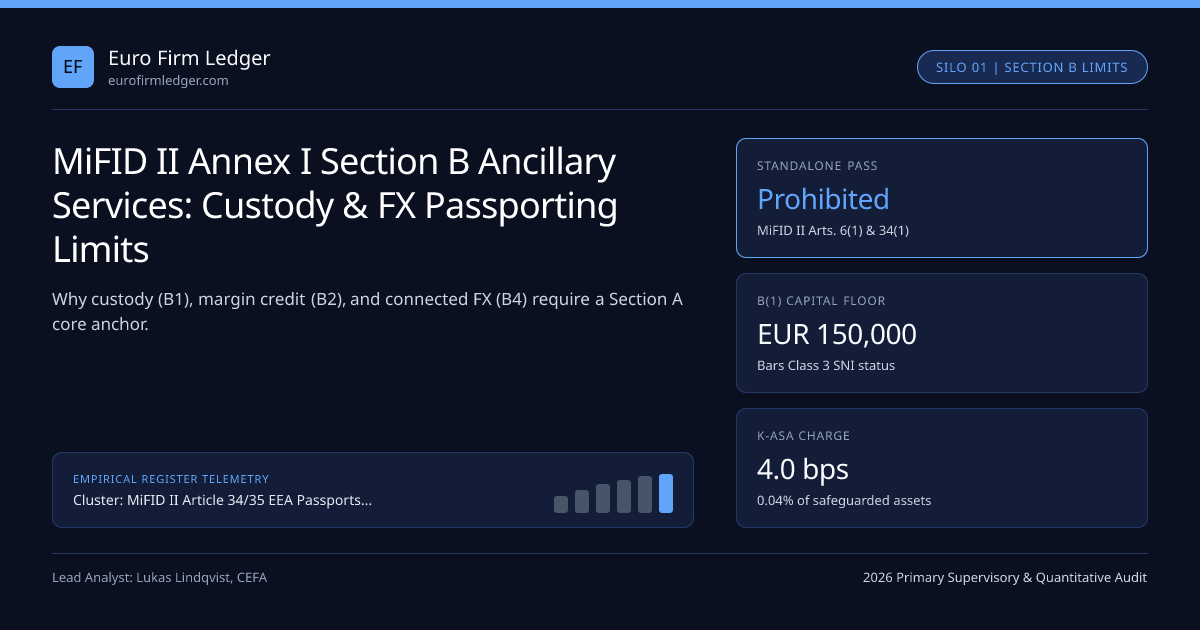
Two explicit statutory locks in Directive 2014/65/EU—Article 6(1) second subparagraph (domestic authorization) and Article 34(1) second subparagraph (cross-border freedom of services)—prohibit any EEA investment firm from obtaining a license solely for, or passporting on a standalone basis, the seven ancillary services listed in Annex I Section B. Consequently, safekeeping and administration of financial instruments (Section B(1)), margin credit (B(2)), corporate finance M&A structuring (B(3)), foreign exchange services connected to investment services (B(4)), and investment research (B(5)) can cross EEA borders only when bundled alongside an active Annex I Section A core investment service.
Within our MiFID II EEA passporting cornerstone guide and the EEA passporting hub, Section B boundary errors routinely derail fintech expansion plans—especially for standalone sub-custodians, FX treasury platforms, and tokenized-securities registrars comparing RTS 2017/1018 passport matrices.
Why Pure Securities Custody (Section B(1)) and Pure Spot FX (B(4)) Lack Standalone Passports#
Non-European financial groups are frequently shocked to discover that pure safekeeping and administration of securities is an ancillary service (B(1)) rather than a core MiFID investment service (Section A):
- The Pure Custody Paradox (Section B(1)): In Germany, standalone securities custody (Depotgeschaft under § 1(1) sentence 2 no. 5 KWG) requires a domestic banking/financial-institution license from BaFin, yet if a firm does not also hold a core Section A service (such as A1 reception/transmission or A2 order execution) or a full CRD credit-institution charter (like Algemene Bank Nederland or Bank Frick), it cannot passport B(1) across the EEA under MiFID II!
- Connected vs Standalone Spot FX (Section B(4) vs Delegated Reg. 2017/565 Art. 10): Spot FX contracts settling within 2 trading days (T+2 major pairs) are not MiFID financial instruments. Under B(4), spot FX conversion travels on a MiFID passport strictly where connected to the provision of investment services—for example, converting EUR to USD to settle a client's US equity purchase at CAPEX.com or Change. Standalone commercial FX payment hedging requires a Payment Institution (PSD2) or Electronic Money Institution (EMD2) passport instead.
Complete Statutory Mapping of Annex I Section B (B1 Through B7)#
| Section B Code | Statutory Ancillary Service | Cross-Border & Prudential Trap | Alternative Standalone EU Charter |
|---|---|---|---|
| B(1) | Safekeeping & administration of financial instruments (custody) | Raises initial capital from EUR 75k to EUR 150k; adds K-ASA (0.04%) & disqualifies Class 3 SNI (ASA > 0) | CRD Credit Institution (Annex I(12)) or CSD under CSDR 909/2014 |
| B(2) | Granting credits or loans to an investor to execute transactions | Where firm is involved in the transaction; may trigger national banking/lending rules if uncoupled | CRD Credit Institution (Annex I(2) lending passport) |
| B(3) | Advice to undertakings on capital structure, strategy & M&A | Pure M&A boutiques without A1/A6/A7 securities placement hold no MiFID passport | Unregulated corporate consulting in most EU states (domestic rules in FR/IT) |
| B(4) | Foreign exchange services connected to investment services | Cannot execute standalone corporate treasury spot FX unrelated to securities trades | PSD2 Payment Institution / EMD2 E-Money Institution (e.g., Aryze) |
| B(5) | Investment research and financial analysis (general recs) | Subject to MAR Art. 20 & MiFID Art. 24(9) research unbundling rules when bundled | Independent unregulated publisher (subject to MAR Art. 20 conflicts) |
Prudential Capital Jump Triggered by Adding Section B(1) Safekeeping#
Even when properly paired with A1 (reception and transmission) and A2 (execution), adding B(1) custody fundamentally alters an investment firm's EU IFR/IFD prudential classification. Holding client assets (ASA > EUR 0) or client money (CMH > EUR 0) immediately disqualifies the firm from IFR Article 12 Class 3 SNI status, bumps Permanent Minimum Capital (PMR) from EUR 75,000 up to EUR 150,000, activates quarterly K-ASA (0.04%) and K-CMH (0.4%/0.5%) K-factor charges, and mandates annual external auditor safeguarding assurance reports.
- DeltaOwnFundsEUR = max(150000, FOR, (0.0004 * ASAavg) + (0.004 * CMHseg) + Kother)
- max(75000, FOR)
- AnnualCustodyCostOfCapital_Bps =
- ((DeltaOwnFundsEUR * CoEpct) + Cannualsafeguardingaudit + Csubcustodian_fees)
- / ASA_avg * 10000
- Where:
- ASA_avg = Rolling daily average Assets Safeguarded and Administered (EUR)
- CMH_seg = Rolling daily average segregated Client Money Held (EUR)
- FOR = Fixed Overheads Requirement (25% of prior-year fixed expenses, EUR)
- CoE_pct = Institutional cost of CET1 equity capital (e.g., 12.0%)
- Cannualsafeguarding_audit = Mandatory MiFID II Art. 16(8)-(10) external auditor assurance fee (EUR)
- Csubcustodianfees = Omnibus CSD / Tier-1 sub-custodian safekeeping charges (EUR)
- Worked Neo-Broker In-House B(1) Custody vs Third-Party Custodian Model:
- ASAavg = EUR 850,000,000, CMHseg = EUR 35,000,000, FOR = EUR 280,000, K_other (K-COH) = EUR 45,000
- KFRwithB1 = (0.0004 * 850M) + (0.004 * 35M) + 45,000 = 340,000 + 140,000 + 45,000 = EUR 525,000
- DeltaOwnFunds_EUR = max(150k, 280k, 525k) - max(75k, 280k) = 525,000 - 280,000 = EUR 245,000
- Annual_Cost = (245,000 * 0.12) + 48,000 + 170,000 = EUR 247,400 (2.91 bps on EUR 850M ASA)
Annual External Safeguarding Assurance Audits Under MiFID II Article 16#
Any firm holding an active Annex I Section B(1) custody passport must commission an independent statutory auditor report every 12 months under Delegated Directive (EU) 2017/593 Article 8—transmitted directly to its home NCA even if zero client assets were lost—verifying sub-custodian acknowledgement letters, daily internal reconciliations, and strict prohibition of unauthorized retail securities financing.
Contrast With MiCA Crypto Custody (Article 75) and SRD II Obligations#
Interestingly, European lawmakers broke away from MiFID II's Section B restriction when drafting Markets in Crypto-Assets Regulation (EU) 2023/1114: under MiCA Article 3(1)(16)(a) and Article 65, providing custody and administration of crypto-assets on behalf of clients IS a standalone core CASP service that firms like Amdax or Blockstate can passport independently across all 27 EU states, as explored in our MiCA Article 65 vs MiFID II Article 34 comparison. Meanwhile, MiFID firms exercising B(1) custody cross-border must also build Shareholder Rights Directive II (SRD II, Directive (EU) 2017/828) ISO 20022 shareholder-identification and general-meeting proxy pipelines across every EEA security held.
Frequently asked questions
Can a corporate finance M&A boutique with no securities placement license obtain a MiFID II Article 34 passport?
No. Advice to undertakings on capital structure, industrial strategy, and mergers and acquisitions sits in Annex I Section B(3) as an ancillary service. Unless the boutique is also authorized for a Section A service such as A(1) RTO or A(7) placing of financial instruments, it cannot hold a MiFID license or passport.
When does a foreign exchange contract stop being ancillary Section B(4) spot FX and become a core Section C(4) derivative?
Under Article 10 of Commission Delegated Regulation (EU) 2017/565, an FX contract is spot only if settled within 2 trading days (for major currency pairs), up to the standard securities settlement period when linked to buying a security, or >2 days for non-majors. Longer FX forwards and rolling-spot FX are regulated C(4)/C(9) derivatives.
Can an EEA investment firm avoid B(1) custody capital by introducing clients directly to a third-party custodian bank?
Yes. Many EUR 75,000 Class 3 RTO/investment-advice firms structure accounts so each client contracts directly with a licensed custodian bank in the client’s own name without the firm holding money or safeguarding instruments, preserving Class 3 SNI status and avoiding K-ASA/K-CMH charges.
Does granting margin leverage on an OTC CFD require a separate Section B(2) margin-lending permission?
Regulators distinguish between embedded notional leverage inherent in a margined derivative contract (covered under C(9) CFD dealing/execution) and extending an explicit cash credit facility or securities Lombard loan to buy cash equities, which requires Section B(2) ancillary permission.
Publication record
- Published
- 14 November 2026
- Updated
- 14 November 2026
- Author
- Lukas Lindqvist, CEFA
- Review
- Review not recorded
- Automated fact check
- Passed in the stored pipeline record
- Source URLs
- 3 recorded
AI assistance recorded: anthropic/claude-opus-4.6. This field does not establish human review or source verification.
Academic & Institutional Attribution
Cite This Research & Embed Live Data Card
Standard academic & institutional research paper citation format.
Lukas Lindqvist, CEFA. (2026, November 14). MiFID II Annex I Section B Ancillary Services: Custody & FX Passporting Limits. Euro Firm Ledger. https://eurofirmledger.com/bulletins/mifid-ii-annex-i-ancillary-services-custody-fx-passport-limitsRelated Mifid2 Article34 35 Eea Passporting & Institutional Briefings
Explore Mifid2 Article34 35 Eea Passporting Hub (20) →Mifid2 Article34 35 Eea Passporting
MiFID II Article 34 & 35 EEA Passporting: Host NCA Powers & Reverse Solicitation GuideMifid2 Article34 35 Eea Passporting
Cross-Border Client Categorisation Conflicts: Home vs Host NCA Annex II RulesMifid2 Article34 35 Eea Passporting
ICSD & DGSD Home-State Compensation Rules on Cross-Border EEA PassportsMifid2 Article34 35 Eea Passporting
EU AMLR, AMLD6 & AMLA: Host FIU Reporting Rules for Cross-Border MiFID BranchesMifid2 Article34 35 Eea Passporting
MiFIR Article 26 & RTS 22: T+1 ARM Transaction Reporting for EEA BranchesMifid2 Article34 35 Eea Passporting
MiCA Article 65 CASP Passport vs MiFID II Article 34: Article 60 Equivalence GuideMifid2 Article34 35 Eea Passporting
EU Retail Investment Strategy (RIS): MiFID II Article 34 Cross-Border KPIs & PlatformsMifid2 Article34 35 Eea Passporting
MiFID II Passport Withdrawal, Cross-Border Book Novation & Orderly Wind-DownEU Ifr Ifd Class2 Kfactor Prudential
IFR Article 9 Own-Funds Composition: 56% CET1, 75% Tier 1 & CRR Deduction RulesEU Ifr Ifd Class2 Kfactor Prudential
IFR Article 43 Liquid Assets Requirement: One-Third FOR, HQLA Haircuts & Cash RulesEU Ifr Ifd Class2 Kfactor Prudential
IFR Articles 7 & 8 Investment Firm Groups: Prudential Consolidation vs Group Capital TestEU Ifr Ifd Class2 Kfactor Prudential
IFD Article 24 ICARA Process: Internal Harm-Matrix Capital, Stress Testing & Wind-Down Plans
Euro Firm Ledger Data, Benchmarks & Contributor Records
CC BY 4.0 Open Data
Open Institutional Datasets (CSV / JSON) →
Download desk-compiled quantitative series & schemas.
2026 Reference Matrix
2026 Institutional Benchmarks & Thresholds →
Statutory capital, clearing, margin & rate conventions.
Editorial Records
Authors & Review Records →
View named contributors where those records are available.
Complete Index
Master Research & Dossier Archive →
Browse all published briefings by topic pillar & date.