
EU Ifr Ifd Class2 Kfactor Prudential
IFR Article 43 Liquid Assets Requirement: One-Third FOR, HQLA Haircuts & Cash Rules
IFR Articles 43-45 obligate EEA investment firms to hold unencumbered liquid assets equal to at least one-third of Fixed Overheads Requirement (1/12th of annual fixed expenses) plus 1.6% of client guarantees.
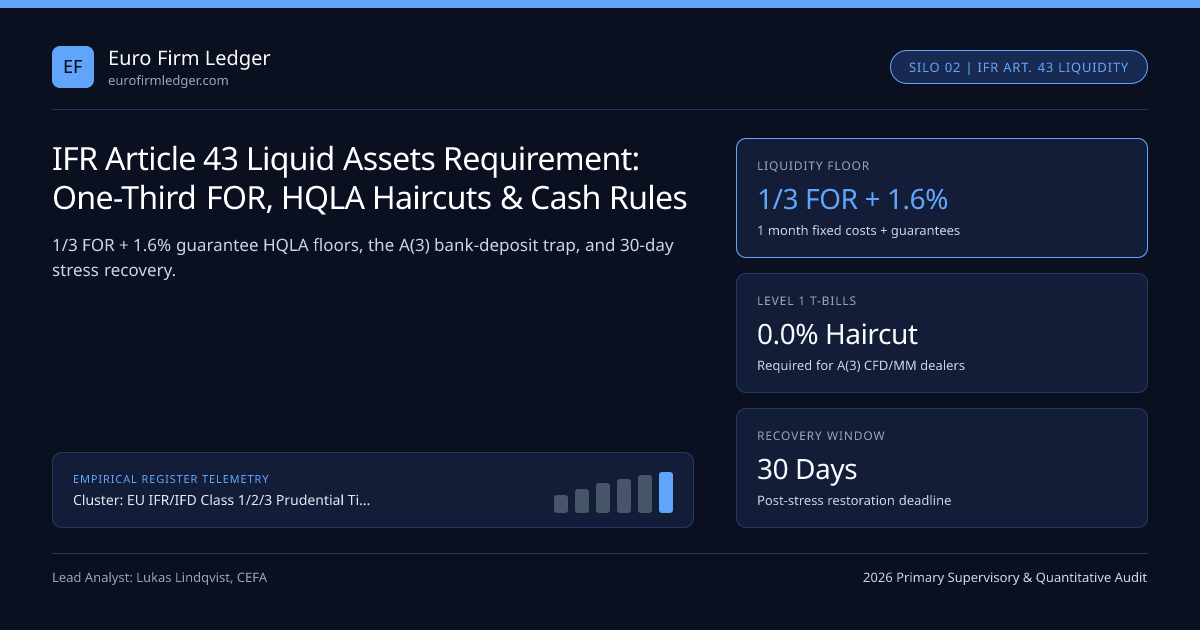
Plenty of investment firms fail with positive accounting equity simply because their own funds are locked inside illiquid office leases, intercompany receivables, or Clearing Member margin deposits when payroll and vendor bills fall due. Part Five of Regulation (EU) 2019/2033 (IFR Articles 43 through 45) establishes the EU's harmonized Liquid Assets Requirement: every Class 2 and non-exempt Class 3 firm must hold unencumbered liquid assets equal to at least *one-third of its Fixed Overheads Requirement (1/3 FOR, or exactly 1 month of net fixed expenses) PLUS 1.6% of total guarantees given to clients**.
Within our EU IFR/IFD prudential capital guide and the IFR/IFD prudential hub, treasury audits conducted by BaFin, CySEC, and ACPR frequently disqualify up to 80% of what brokers thought was liquid cash—because commercial bank deposits held by Class 2 firms generally do NOT count toward the core HQLA liquidity bucket beyond a narrow one-third short-term receivables cap!
Critical Trap: Why Class 2 Commercial Bank Deposits Are Capped at 1/3 of Liquid Assets!#
Read IFR Article 43(1)(a)–(c) with extreme care—it is the single most misunderstood rule in European brokerage treasury management:
- Core HQLA Bucket (IFR Art. 43(1)(a)–(b)): By default, Class 2 firms must satisfy their liquid-asset requirement using CRR LCR Delegated Regulation (EU) 2015/61 Level 1, Level 2A, and Level 2B High-Quality Liquid Assets (central-bank reserves, physical cash, 0% Level 1 German Bunds/French OATs, covered bonds with 7%–15% haircuts, corporate bonds/major equity index shares with 15%–50% haircuts) OR unencumbered own short-term deposits at a central bank.
- Unencumbered Short-Term Bank Deposits Cap (IFR Art. 43(1) third subparagraph): For a Class 2 firm (not authorized for dealing on own account A3 or underwriting A6), unencumbered short-term deposits at commercial credit institutions (like Algemene Bank Nederland or Sydbank) can cover at most one-third (33.3%) of the Liquid Assets Requirement—and for A(3) dealers / A(6) underwriters (like CAPEX.com or B2Prime), commercial bank sight deposits are restricted even further unless converted into short-term sovereign T-bills / Bunds / repo HQLA!
- Generous Class 3 SNI & Non-A3/A6 Relief (IFR Art. 43(2)–(3)): Conversely, Class 3 SNI firms (and non-A3/A6 Class 2 firms under Art. 43(1) third subparagraph rules) enjoy explicit expanded eligibility for unencumbered short-term bank deposits and trade receivables due within 30 days (subject to a 50% haircut).
Eligibility & Haircut Matrix Under IFR Art. 43 & LCR Delegated Reg. 2015/61#
| Asset Type Held on Firm's Own Balance Sheet | LCR / IFR Haircut | Eligible for A3/A6 Class 2 Dealer? | Eligible for Class 3 SNI Firm? | Disqualifying Encumbrance Trap |
|---|---|---|---|---|
| Eurozone Central Gov't T-Bills / Bunds / OATs (Level 1) | 0.0% (100% value) | Yes (Unlimited) | Yes (Unlimited) | Pledged as repo/GCM collateral = disqualified |
| Level 2A Covered & AA- Corporate Bonds | 7.0% to 15.0% | Yes (subject to LCR Level 2 cap) | Yes | Bonds issued by parent/connected group barred |
| Level 2B Major Index Shares (DAX / SX5E) | 50.0% haircut | Yes (within Level 2B ceiling) | Yes | Financial-sector shares barred as HQLA |
| Unencumbered Sight Cash at EU Commercial Bank | 0.0% (where eligible) | Restricted (LCR excludes bank deposits as HQLA!) | Yes (100% under Art. 43(2)) | Minimum balance covenants or bank set-off liens |
| 30-Day Fee & Brokerage Receivables | 50.0% haircut | No (excluded for A3/A6 dealers) | Yes (up to 1/3 of requirement) | Overdue >30 days or disputed invoices barred |
| Segregated / Omnibus Client Money (CMH) | 100% Disqualified | Strictly Prohibited (Art. 43(4)) | N/A (CMH = 0) | Commingling triggers immediate license suspension |
Class 3 SNI Discretionary Exemption Under IFR Article 43(1) Second Subparagraph#
Competent authorities may exempt Class 3 SNI firms completely from the IFR Article 43(1) Pillar 1 liquid-asset requirement (though EBA Guidelines EBA/GL/2022/08 limit blanket exemptions where wind-down friction is elevated, and BaFin § 19 WpIG / CSSF evaluate SNI waivers on a strict risk-proportional basis).
Worked Treasury Re-Allocation for an A(3) Principal CFD Dealer#
See why an A(3) dealer with EUR 4.8 million of annual net fixed overheads (FOR = EUR 1,200,000) holding EUR 900,000 at a commercial bank plus EUR 1.5 million in LP margin accounts actually fails IFR Article 43 until it buys short-term German Bubills:
- (1 / 3) * FOREUR + 0.016 * TotalClientGuaranteesEUR + Pillar2ICARALiquidity_AddOn
- EligibleHQLAValueA3Dealer =
- Sum(Level1SovereignBills * 1.00)
- + min(CapLevel2A, Sum(Level2ABonds * 0.85))
- + min(CapLevel2B, Sum(Level2BAssets * 0.50))
- [Excluding: Client Money, Encumbered LP/GCM Margin, Intragroup Deposits, & Ineligible Bank Balances]
- Worked A(3) Principal Broker Treasury Audit & Fix:
- FOR = EUR 1,200,000; Client Guarantees = EUR 2,500,000
- LAR_EUR = (1,200,000 / 3) + (0.016 * 2,500,000) = 400,000 + 40,000 = EUR 440,000 minimum HQLA
- Before Treasury Fix:
- EUR 1,500,000 cash at Prime Broker LP (Encumbered margin -> EUR 0 eligible)
- EUR 900,000 corporate checking at commercial bank (Ineligible as LCR Level 1 HQLA for A3 dealer!)
- Result: Technical Art. 43 HQLA shortfall despite EUR 2.4M cash on balance sheet!
- After Treasury Fix:
- Sweep EUR 550,000 from checking into unencumbered 3-month German Bubills (0% haircut Level 1 HQLA)
- Eligible HQLA = EUR 550,000 >= EUR 440,000 LAR_EUR (125.0% Liquidity Coverage -> PASS!)
Emergency Monetization & 30-Day Restoration Rule (IFR Art. 43(1))#
Liquid buffers exist to be used—not frozen—during genuine market emergencies. Under IFR Article 43(1) second subparagraph, in exceptional circumstances an investment firm may let its liquid assets dip below 1/3 * FOR by monetizing HQLA to meet acute cash outflows, provided it notifies its home NCA immediately and restores full compliance within 30 calendar days alongside IFD Article 24 ICARA liquidity stress triggers and IFR Article 13 Fixed Overheads Requirement recalculations.
Frequently asked questions
Why don’t ordinary commercial bank checking accounts qualify as Level 1 HQLA for A(3) dealers under LCR rules?
The bank LCR Delegated Regulation (EU) 2015/61 was written for banks—and prevents banks from counting deposits at other commercial banks as HQLA to avoid systemic interbank contagion. Because IFR Article 43(1)(a) imports LCR Articles 10-13 directly without a bank-deposit carve-out for A(3)/A(6) firms, dealers hold short-term sovereign T-bills instead.
Do deposits held at a parent or sister group bank ever count as liquid assets for a Class 3 SNI firm?
No. Even under the broadened bank-deposit allowance for Class 3 SNI and non-dealing firms, financial instruments issued by or deposits placed with parent/subsidiary/connected group entities fail unencumbered independence and contagion rules.
What counts as a "guarantee given to clients" subject to the 1.6% liquidity charge under IFR Article 44?
IFR Article 44 targets explicit financial guarantees or capital-protection commitments extended by an investment firm to clients regarding execution settlement or minimum return floors, requiring 1.6% in liquid HQLA to absorb sudden guarantee calls.
Must liquid assets match the currency denomination of a cross-border broker’s host-state liabilities?
Yes—IFR Article 43(5)-(6) prevents currency-trap mismatches by ensuring firms do not rely excessively on non-convertible third-country currencies to cover EUR or host EEA operational fixed overheads.
Publication record
- Published
- 14 November 2026
- Updated
- 14 November 2026
- Author
- Lukas Lindqvist, CEFA
- Review
- Review not recorded
- Automated fact check
- Passed in the stored pipeline record
- Source URLs
- 3 recorded
AI assistance recorded: anthropic/claude-opus-4.6. This field does not establish human review or source verification.
Academic & Institutional Attribution
Cite This Research & Embed Live Data Card
Standard academic & institutional research paper citation format.
Lukas Lindqvist, CEFA. (2026, November 14). IFR Article 43 Liquid Assets Requirement: One-Third FOR, HQLA Haircuts & Cash Rules. Euro Firm Ledger. https://eurofirmledger.com/bulletins/ifr-article-43-liquid-assets-requirement-one-third-for-haircutsFurther Institutional Analysis & Briefings
EU Ifr Ifd Class2 Kfactor Prudential
IFR Articles 7 & 8 Investment Firm Groups: Prudential Consolidation vs Group Capital TestEU Ifr Ifd Class2 Kfactor Prudential
IFD Article 24 ICARA Process: Internal Harm-Matrix Capital, Stress Testing & Wind-Down PlansEU Ifr Ifd Class2 Kfactor Prudential
IFD Articles 36–40 SREP & Pillar 2R Add-Ons: EBA/ESMA Joint Guidelines ExplainedEU Ifr Ifd Class2 Kfactor Prudential
IFD Articles 30–32 Remuneration Rules: No Bonus Cap, 40% Deferral & MRT ThresholdsEU Ifr Ifd Class2 Kfactor Prudential
IFR Part Six Pillar 3 Public Disclosures: Own Funds, Investment Policy & ESG RulesEU Ifr Ifd Class2 Kfactor Prudential
EBA ITS 2021/2284 Supervisory Reporting: Quarterly COREP IF XBRL Templates & DeadlinesEU Ifr Ifd Class2 Kfactor Prudential
IFR Article 57 Transitional Relief Expiry (June 2026): Full Uncapped Capital Step-UpEU Ifr Ifd Class2 Kfactor Prudential
DORA ICT Operational Risk Inside IFD ICARA: Prudential Capital Modeling for Cyber EventsBafin Wplg Amf Consob Cnmv Supervision
Germany BaFin WpIG & Deutsche Bundesbank Dual Supervision: § 15 Licensing & TiersBafin Wplg Amf Consob Cnmv Supervision
BaFin CFD & Futures Product Intervention: Germany’s Nachschusspflicht Ban ExplainedBafin Wplg Amf Consob Cnmv Supervision
BaFin MaComp Circular (BT 3, BT 5 & BT 13): German Inducements, Cost Info & Target MarketsBafin Wplg Amf Consob Cnmv Supervision
France AMF Loi Sapin 2 (Article L. 533-12-7): Electronic Derivative Advertising Ban
Euro Firm Ledger Data, Benchmarks & Contributor Records
CC BY 4.0 Open Data
Open Institutional Datasets (CSV / JSON) →
Download desk-compiled quantitative series & schemas.
2026 Reference Matrix
2026 Institutional Benchmarks & Thresholds →
Statutory capital, clearing, margin & rate conventions.
Editorial Records
Authors & Review Records →
View named contributors where those records are available.
Complete Index
Master Research & Dossier Archive →
Browse all published briefings by topic pillar & date.