
EU Ifr Ifd Class2 Kfactor Prudential
IFR Part Six Pillar 3 Public Disclosures: Own Funds, Investment Policy & ESG Rules
IFR Part Six (Articles 46-53) requires Class 2 investment firms—and AT1-issuing Class 3 SNI firms—to publish standardized annual Pillar 3 disclosures covering risk management, own funds, remuneration, voting, and ESG.
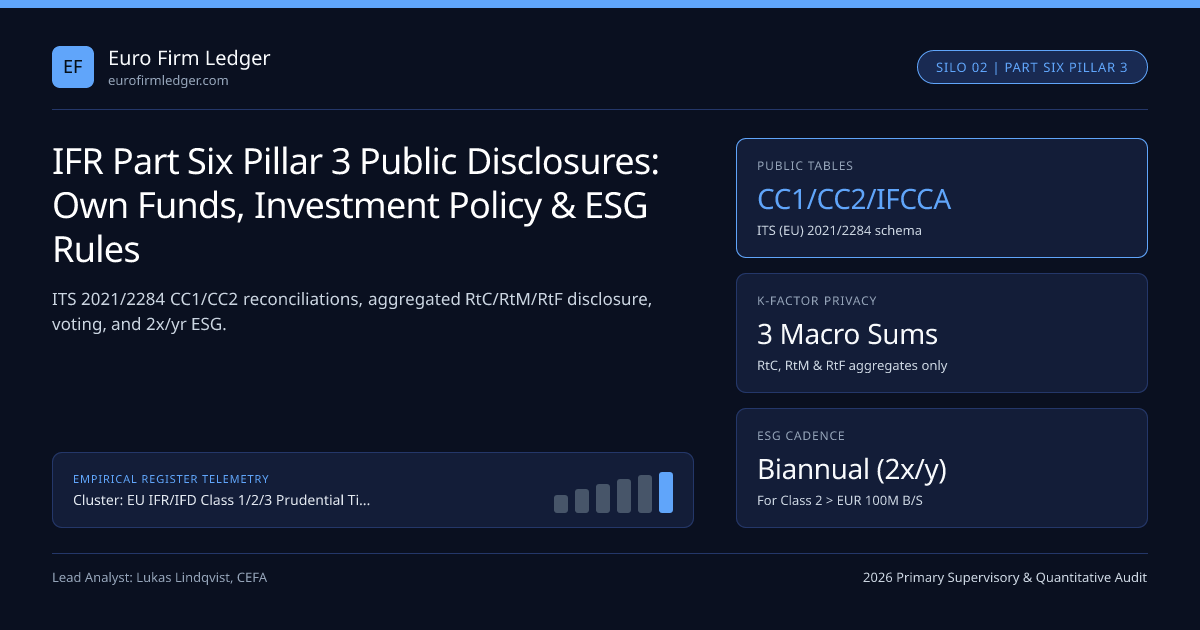
Market discipline under Part Six of Regulation (EU) 2019/2033 (IFR Articles 46 through 53) obligates every Class 2 investment firm—plus any Class 3 SNI firm that issues Additional Tier 1 instruments (IFR Article 46(2))—to publish an annual standalone Pillar 3 Disclosure Report on the exact same date it publishes its annual financial statements. Standardized across Europe by Commission Implementing Regulation (EU) 2021/2284 (EU IF CC1, EU IF CC2, EU IFCCA) and Commission Delegated Regulation (EU) 2022/1159 (Investment Policy RTS), Pillar 3 exposes a broker's exact CET1 balance-sheet reconciliation, K-factor breakdown, binding SREP Pillar 2R ratio, MRT bonus aggregates, shareholder proxy-voting behavior, and ESG physical/transition risks to public institutional counterparties!
Within our EU IFR/IFD prudential capital guide and the IFR/IFD prudential hub, annual website sweeps by CySEC, BaFin, CSSF, and AFM routinely cite Class 2 firms like retail CFD brokers and mid-tier asset managers for burying outdated PDF summaries or omitting mandatory EU IF CC2 statutory-balance-sheet cross-references.
Scope & Proportionality Matrix Across IFR Articles 46–53#
Not every Part Six article applies to every Class 2 firm—Articles 52 (Investment Policy / Shareholder Voting) and 53 (ESG Risks) activate only above the EUR 100 million 4-year rolling asset threshold of IFD Article 32(4)(a):
| IFR Article | Disclosure Topic | Applies to Class 3 SNI? | Applies to All Class 2? | Special Threshold / Standard Template |
|---|---|---|---|---|
| Art. 47 | Risk Management Objectives & Policies | Only if AT1 issued | Yes (100% Class 2) | Narrative covering RtC, RtM, RtF & liquidity strategies |
| Art. 48 | Governance (Directorships & Diversity) | Only if AT1 issued | Yes (100% Class 2) | Count of exec/non-exec directorships + board diversity target % |
| Art. 49 | Own Funds Reconciliation | Only if AT1 issued | Yes (100% Class 2) | Mandatory ITS 2021/2284 EU IF CC1, CC2 & IFCCA tables! |
| Art. 50 | Own Funds Requirements (PMR, FOR, KFR, P2R) | Only if AT1 issued | Yes (100% Class 2) | Group K-factors into 3 aggregate buckets: RtC, RtM & RtF |
| Art. 51 | Remuneration Policy & MRT Pay Splits | No | Yes (100% Class 2) | Fixed/variable split, cash/instruments, deferred & sign-on/severance |
| Art. 52 | Investment Policy & Shareholder Voting | No | Only > EUR 100M B/S | RTS 2022/1159 (IF IP1 / IP2): only where listed EU equity stakes > 5% voting rights! |
| Art. 53 | Environmental, Social & Governance (ESG) Risks | No | Only > EUR 100M B/S | Semi-annual disclosure of physical & transition ESG risks! |
Competitive Confidentiality Protection in IFR Article 50(b): Aggregated K-Factors#
Proprietary trading firms in Amsterdam and Frankfurt initially feared that disclosing individual K-factors (K-DTF, K-NPR, K-CMG, K-ASA) would let rivals reverse-engineer their exact daily turnover and clearing-margin footprints. EU lawmakers accommodated that concern in IFR Article 50(b): firms disclose K-factor capital publicly solely in aggregate form across the three macro buckets (Total RtC, Total RtM, and Total RtF) rather than exposing each of the nine underlying K-factors!
Deep Dive Into IFR Article 52 Investment Policy (RTS 2022/1159)#
Even when a Class 2 asset manager exceeds EUR 100 million in balance-sheet assets, IFR Article 52(1) and (3) plus RTS (EU) 2022/1159 narrow proxy-voting templates (IF IP1 and IF IP2) strictly to regulated-market shares where the proportion of voting rights held directly or indirectly (including discretionary client mandates where the firm holds voting power!) exceeds 5% of all voting rights issued by the company—saving diversified index and ETF managers from publishing 10,000-line voting spreadsheets.
Reconciliation Integrity Verification Between Pillar 3 CC2 and COREP IF 01#
Before posting the Pillar 3 report onto the corporate website of a firm like CAPEX.com, Bitpanda, or Bank Frick's EU entities, CFOs run an automated three-way tie-out across Audited IFRS Statements, COREP XBRL (IF 01.00), and Pillar 3 (EU IF CC1 / CC2):
- IFRSTotalEquity_Published
- UnauditedOrForeseeableDividendDistribution
- IntangibleAssetsGoodwillAndDTADeductionsCC1
- + EligibleAT1AndAmortizedTier2SubDebtCC1
- === PublishedPillar3OwnFundsRow1 (EUIF_CC1)
- === YearEndCOREPXBRLCell (IF0100r0010_c0010)
- PublicSolvencyRatioDisclosureCheck (IFRArt50):
- PublishedTotalCapitalRatio = PublishedPillar3OwnFunds / max(PMR, FOR, RtC + RtM + RtF)
- MinimumCompliantPublicRatio >= 100.0% + (P2RArt40 / D_Pillar1) * 100%
- Worked Class 2 Broker Year-End Pillar 3 Summary Table:
- IFRS Audited Total Shareholders' Equity = EUR 5,420,000; Foreseeable Board Dividend = -EUR 600,000
- Less Software & DTA Regulatory Deductions = -EUR 370,000 -> Published CET1 (CC1) = EUR 4,450,000
- Amortized Tier 2 Subordinated Loan = +EUR 550,000 -> Total Own Funds = EUR 5,000,000
- Published Art. 50 Floors: PMR = EUR 750k | FOR = EUR 1,800k | KFR = EUR 2,500k (RtC 620k + RtM 1,450k + RtF 430k)
- Published Solvency Ratio = 5,000,000 / 2,500,000 = 200.00% (vs 120.00% binding TSCR including 20% P2R)
GDPR Anonymization Safeguard for Small MRT Cohorts (IFR Art. 51(4))#
What if a boutique Class 2 firm has only 1 or 2 Material Risk Takers outside the board—meaning publishing a separate quantitative bonus column for "other MRTs" would reveal a single named trader's exact salary to the public in violation of Regulation (EU) 2016/679 (GDPR)? IFR Article 51(4) explicitly mandates that Pillar 3 remuneration disclosures comply with EU data-protection law, permitting firms with tiny MRT cohorts to aggregate senior management and other MRT columns together (while explaining the GDPR aggregation reason in a footnote) rather than exposing identifiable individual pay under IFD Articles 30–32 MRT bonus rules!
Frequently asked questions
Must an EU subsidiary publish its own solo Pillar 3 report if its EU parent holding publishes a consolidated Pillar 3?
Generally no! Under IFR Article 7(1) and Article 46(1), where an investment firm group applies full IFR Article 7 prudential consolidation, Part Six Pillar 3 disclosures are published at the consolidated EU parent level rather than duplicating solo disclosures for every subsidiary (unless using Article 8 GCT, which keeps Part Six solo!).
Can a firm omit proprietary business information from its Pillar 3 report on confidentiality grounds?
Unlike CRR Article 432 for banks, IFR Part Six does NOT contain a broad general "proprietary/confidentiality waiver" allowing firms to skip Articles 47-51 tables—because lawmakers already built confidentiality relief directly into the aggregated RtC/RtM/RtF design and GDPR MRT aggregation!
Why does IFR Article 53 require ESG disclosures TWICE a year when the rest of Pillar 3 is annual?
IFR Article 53 specifically states that large (>EUR 100M) investment firms shall disclose information on physical and transition ESG risks once in the first year and biannually (twice per year) thereafter, aligning semi-annual climate risk tracking with CRR Article 449a.
Does an external statutory auditor have to issue a separate audit opinion on the Pillar 3 document?
IFR Article 46(4) leaves mandatory external audit of Pillar 3 to national law or NCA instruction, though national transpositions (such as German WpIG audit report rules) require statutory auditors to verify that Pillar 3 own-funds reconciliations match audited accounts without material misstatement.
Publication record
- Published
- 14 November 2026
- Updated
- 14 November 2026
- Author
- Lukas Lindqvist, CEFA
- Review
- Review not recorded
- Automated fact check
- Passed in the stored pipeline record
- Source URLs
- 4 recorded
AI assistance recorded: anthropic/claude-opus-4.6. This field does not establish human review or source verification.
Academic & Institutional Attribution
Cite This Research & Embed Live Data Card
Standard academic & institutional research paper citation format.
Lukas Lindqvist, CEFA. (2026, November 14). IFR Part Six Pillar 3 Public Disclosures: Own Funds, Investment Policy & ESG Rules. Euro Firm Ledger. https://eurofirmledger.com/bulletins/ifr-part-six-pillar-3-public-disclosures-esg-voting-own-fundsFurther Institutional Analysis & Briefings
EU Ifr Ifd Class2 Kfactor Prudential
EBA ITS 2021/2284 Supervisory Reporting: Quarterly COREP IF XBRL Templates & DeadlinesEU Ifr Ifd Class2 Kfactor Prudential
IFR Article 57 Transitional Relief Expiry (June 2026): Full Uncapped Capital Step-UpEU Ifr Ifd Class2 Kfactor Prudential
DORA ICT Operational Risk Inside IFD ICARA: Prudential Capital Modeling for Cyber EventsBafin Wplg Amf Consob Cnmv Supervision
Germany BaFin WpIG & Deutsche Bundesbank Dual Supervision: § 15 Licensing & TiersBafin Wplg Amf Consob Cnmv Supervision
BaFin CFD & Futures Product Intervention: Germany’s Nachschusspflicht Ban ExplainedBafin Wplg Amf Consob Cnmv Supervision
BaFin MaComp Circular (BT 3, BT 5 & BT 13): German Inducements, Cost Info & Target MarketsBafin Wplg Amf Consob Cnmv Supervision
France AMF Loi Sapin 2 (Article L. 533-12-7): Electronic Derivative Advertising BanBafin Wplg Amf Consob Cnmv Supervision
France ACPR & AMF Twin-Peaks Licensing: Entreprise d’Investissement (EI) vs SGP RulesBafin Wplg Amf Consob Cnmv Supervision
Spain CNMV July 2023 CFD Intervention: Total Retail Ad, Affiliate & Sponsorship BanBafin Wplg Amf Consob Cnmv Supervision
Spain CNMV Circular 1/2022 & Complex Product Handwritten Risk Warnings GuideBafin Wplg Amf Consob Cnmv Supervision
Italy CONSOB Article 7-octies TUF & Decreto Crescita: ISP Website Blackout PowersBafin Wplg Amf Consob Cnmv Supervision
Italy SIM Licensing (Article 19 TUF): CONSOB & Banca d’Italia Twin-Peaks Supervision
Euro Firm Ledger Data, Benchmarks & Contributor Records
CC BY 4.0 Open Data
Open Institutional Datasets (CSV / JSON) →
Download desk-compiled quantitative series & schemas.
2026 Reference Matrix
2026 Institutional Benchmarks & Thresholds →
Statutory capital, clearing, margin & rate conventions.
Editorial Records
Authors & Review Records →
View named contributors where those records are available.
Complete Index
Master Research & Dossier Archive →
Browse all published briefings by topic pillar & date.