
EU Ifr Ifd Class2 Kfactor Prudential
IFR Article 57 Transitional Relief Expiry (June 2026): Full Uncapped Capital Step-Up
On June 26, 2026, all five-year transitional own-funds caps under IFR Article 57(1)-(4) expire across the EEA—lifting 2x legacy CRR ceilings and forcing capped advisers, brokers, and commodity dealers onto 100% uncapped IFR capital.
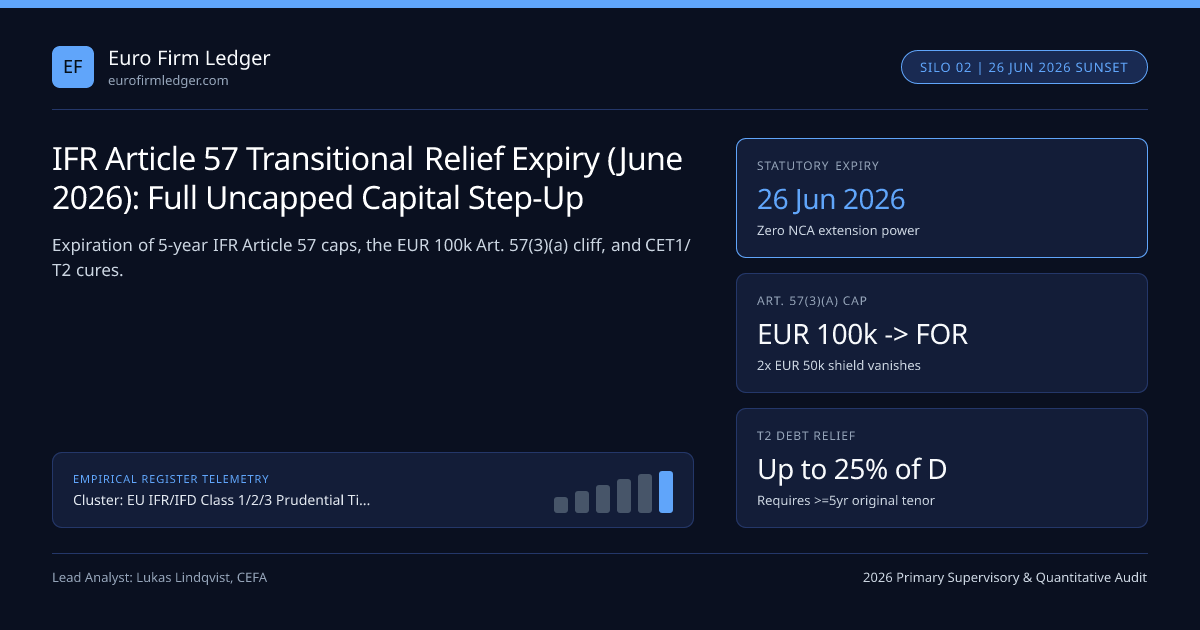
Mark June 26, 2026 in red ink on every European prudential calendar: exactly five years after Regulation (EU) 2019/2033 entered into application on June 26, 2021, the sweeping transitional own-funds caps in IFR Article 57(1), (3), and (4) expire permanently by operation of law. Over the 2021–2026 transition period, hundreds of former "exempt CAD" advisers, CRR Article 95(2)/96(2) firms, legacy EUR 50,000 boutiques, and specialized commodity/emission-allowance dealers relied on Article 57 to cap their Pillar 1 capital at twice their legacy CRR requirement or twice legacy FOR. Beginning with the Q2 2026 (30 June 2026) COREP IF snapshot, every single transitional shield disappears—exposing under-prepared firms to overnight 150% to 400% CET1 step-ups!
Within our EU IFR/IFD prudential capital guide and the IFR/IFD prudential hub, supervisory readiness letters from BaFin, CSSF, AFM, and CySEC warn boards that no further legislative extension exists for Article 57(1)–(4).
Complete Breakdown of Expiring IFR Article 57 Transitional Provisions#
Four distinct cohorts of EEA investment firms lose transitional protection simultaneously on June 26, 2026 (while one special local-firm carve-out under Article 57(2) runs until June 26, 2026 / specific review timelines):
| IFR Art. 57 Clause | Protected Legacy Cohort (2021–2026) | Transitional Cap Formula (Until 25 Jun 2026) | Post-26 June 2026 Uncapped Rule |
|---|---|---|---|
| Art. 57(1) | Standard CRR investment firms whose KFR/FOR jumped sharply in 2021 | Capped at 2x legacy CRR Pillar 1 own-funds requirement (if lower than IFR) | 100% uncapped max(PMR, FOR, KFR) |
| Art. 57(3)(a) | Former CRR-exempt / EUR 50k advisory & RTO firms never previously subject to FOR | Capped at 2x legacy EUR 50k initial capital (EUR 100,000) regardless of actual FOR! | 100% uncapped 25% FOR + KFR (often EUR 400k–1.5M+!) |
| Art. 57(3)(b) | Pre-existing firms that lacked prior FOR / K-factor history | Capped at 2x FOR (shielding high-volume low-overhead firms from KFR) | 100% uncapped KFR where KFR > 2 * FOR |
| Art. 57(4) | Legacy EUR 50,000 & EUR 125,000 firms stepping up to EUR 75k / EUR 150k PMR | Allowed EUR 5,000/yr incremental PMR step-up from EUR 50k/125k base | Full EUR 75,000 / EUR 150,000 PMR mandatory |
| Art. 57(2) & (6) | Former "local firms" (CRR Art. 4(1)(4)) & specialized commodity/emission dealers | Capped at EUR 250,000 (+EUR 100k/yr) stepping toward EUR 750k PMR / K-NPR relief | Full EUR 750,000 PMR + full K-NPR / K-TCD / K-DTF! |
Hardest-Hit Segment: High-Payroll Advisory Boutiques Under Article 57(3)(a)#
Look at why IFR Article 57(3)(a) creates the steepest single-day cliff in European wealth management: prior to June 2021, pure investment-advice and RTO firms in several EU states held just EUR 50,000 of initial capital with no Fixed Overheads Requirement. Under Article 57(3)(a), their total IFR own-funds requirement from 2021 to June 25, 2026 was capped at 2 * EUR 50,000 = EUR 100,000—even if the firm employed 35 advisers in Munich, Paris, or Luxembourg with EUR 4,800,000 in annual fixed payroll and office rent (Uncapped FOR = EUR 1,200,000)! On June 26, 2026, that boutique's minimum regulatory own funds leaps 12x overnight from EUR 100,000 to EUR 1,200,000!
Commodity & Emission-Allowance Dealers Exiting Article 57(1)/(6) Relief#
Similarly, energy and EU ETS carbon-allowance trading houses licensed under MiFID II (where failing the ancillary-activity exemption under MiFID II Article 2(1)(j)) relied heavily on Article 57 caps while building CET1 reserves against volatile gas/power K-NPR (15% net + 3% gross) and K-TCD (18% commodity PFE).
Quantifying the June 26, 2026 Capital Injection Requirement#
CFOs must fund not just 100% of uncapped D_uncapped, but also any multiplicative SREP Pillar 2R and internal Yellow EWI management buffer prior to June 26, 2026:
- Dcappedpresunset = min(Duncapped, CapArt572x_Legacy)
- Dpostsunset = max(PMRfull75k150k750k, FORfull, KFRfull)
- TargetPostSunsetOF = Dpostsunset * (1 + P2Rpct + MgmtBufferpct)
- MinimumNewCET1_Required (Assuming AT1 = EUR 0) =
- max(0, 0.75 * (Dpostsunset * (1 + P2Rpct)) + MgmtBufferEUR - CurrentEligible_CET1)
- Worked High-Overhead Multi-Family Advisory Firm Exiting Art. 57(3)(a) EUR 100k Cap:
- Annual Net Fixed Overheads = EUR 3,600,000 -> Uncapped FOR = 0.25 * 3,600,000 = EUR 900,000 (Class 3 SNI)
- Pre-26-June-2026 Capped Requirement (Art. 57(3)(a)) = EUR 100,000; Current Retained CET1 = EUR 310,000
- Post-26-June-2026 Uncapped Requirement (Dpostsunset) = max(75,000, 900,000) = EUR 900,000 (+800% jump!)
- With 15% Internal Management Buffer -> Target Own Funds = EUR 1,035,000
- Optimal Mix: 75% CET1 on EUR 900k (+EUR 135k buffer) = EUR 810,000 CET1 + EUR 225,000 7-yr Tier 2 Sub-Loan
- Required Pre-26-June Injection = +EUR 500,000 Paid-In CET1 + EUR 225,000 Tier 2 Shareholder Loan!
Strategic Alternatives for Firms Unable to Fund the Uncapped Jump#
Where aging founder-owners of smaller European advisory boutiques choose not to lock EUR 600,000–1,000,000 of dead personal cash onto a standalone balance sheet before June 26, 2026, M&A advisors execute two clean structural exits across Germany, France, Cyprus, and Luxembourg: (1) surrendering the standalone license and becoming an Article 29 tied agent / liability umbrella partner under a well-capitalized platform (such as German Haftungsdach networks), or (2) merging with a peer wealth manager to spread fixed compliance/IT overheads across double the revenue base.
Frequently asked questions
Did IFR Article 57 also cap the IFR Article 43 one-third FOR Liquid Assets Requirement until 2026?
No! IFR Article 57 transitional caps applied solely to own-funds requirements (Part Three). Unless exempted as a Class 3 SNI firm by its NCA under Article 43(1), every firm has already been subject to the full uncapped 1/3 FOR liquid-asset requirement since June 26, 2021.
Why does the Q2 2026 COREP return (30 June 2026) reflect 100% uncapped capital when the cap expired only 4 days earlier on 26 June?
COREP IF templates IF 01 and IF 02.01 measure point-in-time solvency at close of business on the quarterly reference date (30 June 2026)—and under IFR Article 11(1), investment firms must satisfy uncapped own-funds requirements at all times from 26 June 2026 onward.
Can a firm apply to BaFin, CSSF, or CySEC for an individual 2-year hardship extension past June 26, 2026?
No. Because IFR (Regulation (EU) 2019/2033) is a directly applicable EU Regulation rather than a national directive, national competent authorities have zero legal power to extend expired Article 57 deadlines unilaterally beyond the June 26, 2026 statutory date.
How does migrating onto a German Haftungsdach (MiFID Article 29 tied-agent umbrella) eliminate IFR capital?
A tied agent surrenders its own MiFID/WpIG license and operates exclusively under the license and unconditional liability of a principal WpIG institution—meaning the tied agent ceases to be an IFR investment firm, while its revenue and client orders roll into the principal umbrella’s FOR and K-COH/K-AUM.
Publication record
- Published
- 14 November 2026
- Updated
- 14 November 2026
- Author
- Lukas Lindqvist, CEFA
- Review
- Review not recorded
- Automated fact check
- Passed in the stored pipeline record
- Source URLs
- 4 recorded
AI assistance recorded: anthropic/claude-opus-4.6. This field does not establish human review or source verification.
Academic & Institutional Attribution
Cite This Research & Embed Live Data Card
Standard academic & institutional research paper citation format.
Lukas Lindqvist, CEFA. (2026, November 14). IFR Article 57 Transitional Relief Expiry (June 2026): Full Uncapped Capital Step-Up. Euro Firm Ledger. https://eurofirmledger.com/bulletins/ifr-article-57-transitional-five-year-own-funds-cap-expiry-impactFurther Institutional Analysis & Briefings
EU Ifr Ifd Class2 Kfactor Prudential
DORA ICT Operational Risk Inside IFD ICARA: Prudential Capital Modeling for Cyber EventsBafin Wplg Amf Consob Cnmv Supervision
Germany BaFin WpIG & Deutsche Bundesbank Dual Supervision: § 15 Licensing & TiersBafin Wplg Amf Consob Cnmv Supervision
BaFin CFD & Futures Product Intervention: Germany’s Nachschusspflicht Ban ExplainedBafin Wplg Amf Consob Cnmv Supervision
BaFin MaComp Circular (BT 3, BT 5 & BT 13): German Inducements, Cost Info & Target MarketsBafin Wplg Amf Consob Cnmv Supervision
France AMF Loi Sapin 2 (Article L. 533-12-7): Electronic Derivative Advertising BanBafin Wplg Amf Consob Cnmv Supervision
France ACPR & AMF Twin-Peaks Licensing: Entreprise d’Investissement (EI) vs SGP RulesBafin Wplg Amf Consob Cnmv Supervision
Spain CNMV July 2023 CFD Intervention: Total Retail Ad, Affiliate & Sponsorship BanBafin Wplg Amf Consob Cnmv Supervision
Spain CNMV Circular 1/2022 & Complex Product Handwritten Risk Warnings GuideBafin Wplg Amf Consob Cnmv Supervision
Italy CONSOB Article 7-octies TUF & Decreto Crescita: ISP Website Blackout PowersBafin Wplg Amf Consob Cnmv Supervision
Italy SIM Licensing (Article 19 TUF): CONSOB & Banca d’Italia Twin-Peaks SupervisionBafin Wplg Amf Consob Cnmv Supervision
Netherlands AFM Turbos Leverage Intervention & RTS 6 Algorithmic Trading SupervisionBafin Wplg Amf Consob Cnmv Supervision
Belgium FSMA 2016 Royal Decree: Europe’s Complete OTC Retail CFD Distribution Ban
Euro Firm Ledger Data, Benchmarks & Contributor Records
CC BY 4.0 Open Data
Open Institutional Datasets (CSV / JSON) →
Download desk-compiled quantitative series & schemas.
2026 Reference Matrix
2026 Institutional Benchmarks & Thresholds →
Statutory capital, clearing, margin & rate conventions.
Editorial Records
Authors & Review Records →
View named contributors where those records are available.
Complete Index
Master Research & Dossier Archive →
Browse all published briefings by topic pillar & date.