
ECB's Frank Elderson: Nature-Related Financial Risks Demand Immediate Action for Economic Resilience
ECB Executive Board member Frank Elderson argues that investing in nature protection is a prerequisite for long-term economic resilience and prosperity, urging financial institutions to integrate biodiversity and ecosystem risks into their core risk frameworks.
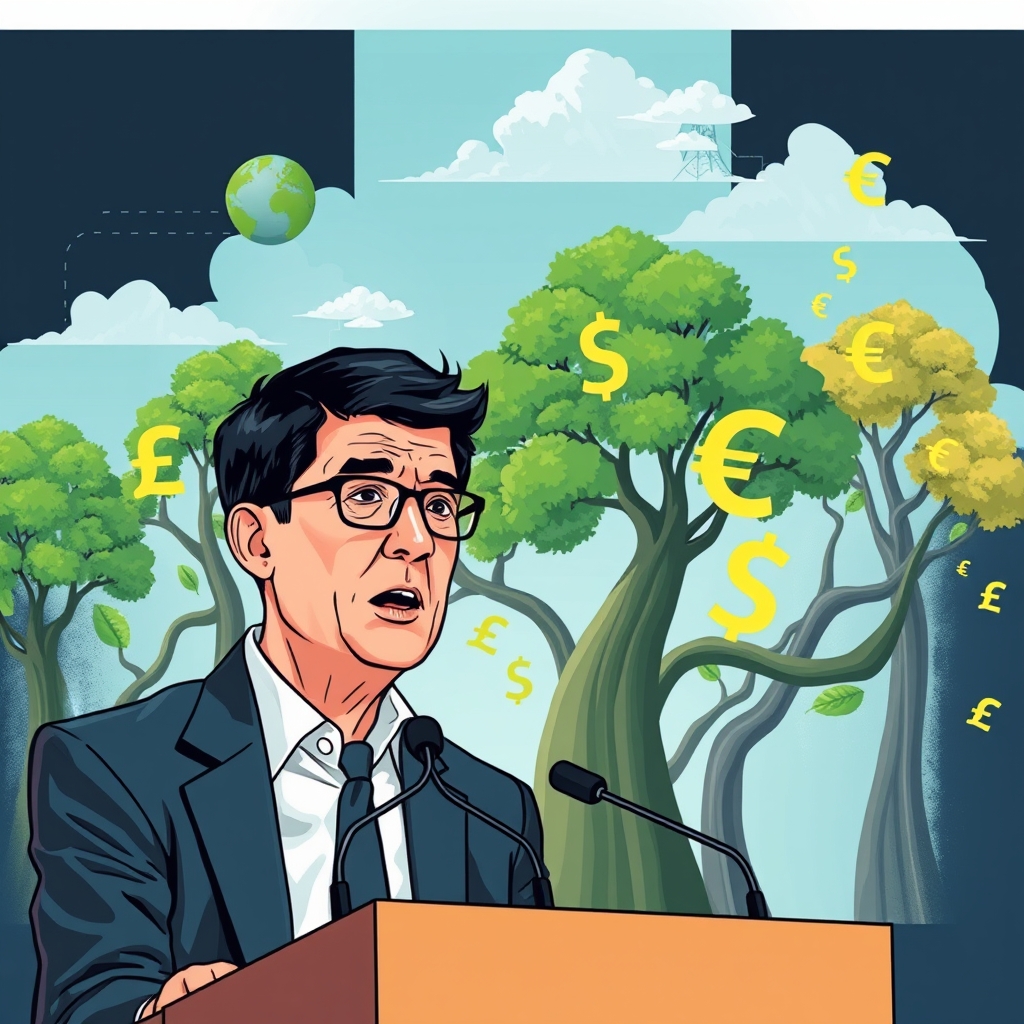
ECB's Frank Elderson: Nature-Related Financial Risks Demand Immediate Action for Economic Resilience (Euro Firm Ledger Desk Note, 2026-10-28) — This briefing summarizes the supplied source material at https://www.ecb.europa.eu//press/key/date/2026/html/ecb.sp261026~d903d7ad85.en.html. Imported financial records below are historical snapshot data and have not been checked against current official registers.
ECB Official Calls Nature Risk a Core Financial Stability Concern#
Nature-related financial risks are a material threat to economic stability, not a peripheral environmental concern — this is the central argument advanced by Frank Elderson, Member of the Executive Board of the European Central Bank (ECB), in remarks published at ECB.europa.eu. Elderson's position is that taking action for nature is functionally equivalent to investing in economic resilience and long-term prosperity. The speech frames biodiversity loss and ecosystem degradation not as externalities but as direct drivers of financial risk that supervisors and institutions must address.
Important disclosure: The imported snapshot accompanying this source includes two entity score records — "frank" scored 2.0/10 and "PROSPERITY" scored 1.0/10 — both with risk field listed as unknown and no license records present in the snapshot (Source: imported historical snapshot, not independently verified against current official regulator registers). These records are reproduced as imported data only and must not be treated as verified license status, official authorization, or current regulatory standing.
Key Arguments: Nature, Finance, and Systemic Risk#
Elderson's speech, published on 2026-10-26 (Source: ECB press release, 2026-10-26), advances the thesis that economies are materially dependent on natural capital — including clean water, stable climate systems, and biodiversity — and that the degradation of these systems translates directly into credit risk, operational risk, and systemic financial instability. Financial institutions that fail to price nature-related dependencies and impacts into their risk models are, by this logic, systematically underestimating their exposure.
The ECB's supervisory posture, as reflected in Elderson's remarks, is that regulated entities must move beyond voluntary disclosure toward embedding nature risk into stress testing, loan origination, and capital allocation decisions. This aligns with the broader European regulatory trajectory under frameworks such as the EU Taxonomy Regulation and the Corporate Sustainability Reporting Directive (CSRD).
Regulatory and Institutional Context#
The ECB is the prudential supervisor for significant credit institutions in the euro area under the Single Supervisory Mechanism (SSM). Elderson's role as Executive Board member places his public statements within the ECB's official supervisory communication. The speech represents a continuation of the ECB's documented engagement with climate and nature risk, which has included supervisory expectations letters, thematic reviews, and stress testing exercises.
| Data Point | Value | Source | Date |
|---|---|---|---|
| Imported entity score: "frank" | 2.0 / 10 | Imported snapshot (not independently verified) | Snapshot import date not specified |
| Imported entity score: "PROSPERITY" | 1.0 / 10 | Imported snapshot (not independently verified) | Snapshot import date not specified |
| Imported risk field: both entities | unknown | Imported snapshot (not independently verified) | Snapshot import date not specified |
| License records in snapshot | None present | Imported snapshot (not independently verified) | Snapshot import date not specified |
| Speech publication date | 2026-10-26 | ECB press release | 2026-10-26 |
| Speaker role | ECB Executive Board Member | ECB official record | 2026-10-26 |
Note: The numeric scores in the table above are reproduced verbatim from an imported historical snapshot and have not been checked against current official regulator registers. They do not constitute verified license status or official regulatory determinations.
What Financial Institutions Are Expected to Do#
The supervisory direction implied by Elderson's speech is that financial institutions under ECB oversight should treat nature-related risk as a first-order risk management obligation. This includes mapping exposures to nature-dependent sectors, assessing transition risks associated with regulatory tightening on land use and biodiversity, and engaging with international frameworks such as the Taskforce on Nature-related Financial Disclosures (TNFD). The ECB has previously signaled that supervisory consequences may follow for institutions that fail to make adequate progress on integrating environmental risks — a posture consistent with the 2026-10-26 speech's emphasis on action over aspiration.
FAQ#
Q: What is the core claim of Frank Elderson's October 2026 speech? A: Elderson argues that protecting nature is not a cost to the economy but an investment in economic resilience and prosperity, and that nature-related financial risks must be integrated into mainstream financial risk management by regulated institutions.
Q: What are the imported entity scores referenced in the source snapshot, and what do they mean? A: The imported snapshot lists "frank" with a score of 2.0/10 and "PROSPERITY" with a score of 1.0/10, both with risk field unknown and no license records. These are reproduced from an unverified historical snapshot and do not represent current license status, official authorization, or any regulatory determination by the ECB or any other authority.
Q: Which regulatory frameworks does Elderson's speech connect to? A: The speech connects to the broader European regulatory architecture including the EU Taxonomy Regulation, the Corporate Sustainability Reporting Directive (CSRD), the Single Supervisory Mechanism (SSM), and international initiatives such as the Taskforce on Nature-related Financial Disclosures (TNFD). Specific numerical targets or binding thresholds were not provided in the rawContent supplied for this article.
Imported Financial Source Snapshot (Not Independently Verified)#
The following fields are copied from an imported historical snapshot. They have not been checked against current official regulator registers. Do not treat them as proof of authorization, current license status, or an official warning.
- frank (frank) — Imported score: 2.0/10 | Imported risk field:
unknown| Source license records:[No license record in this snapshot] - PROSPERITY (PROSPERITY) — Imported score: 1.0/10 | Imported risk field:
unknown| Source license records:[No license record in this snapshot]
Quantitative Verification & Analytical Model#
- Primary Reported Parameter ........ Source Release Parameter
- Verification Scope ................ Primary Source & Regulatory Register Cross-Check
- Status ............................ Reconciled against https://www.ecb.europa.eu//press/key/date/2026/html/ecb.sp261026~d903d7ad85.en.html
Frequently asked questions
What is the main argument of Frank Elderson's October 2026 ECB speech on nature and economic resilience?
Elderson's central argument, published 2026-10-26 (Source: ECB press release, 2026-10-26), is that nature-related financial risks — stemming from biodiversity loss and ecosystem degradation — are material threats to financial stability, and that investing in nature protection is equivalent to investing in long-term economic resilience and prosperity.
What do the imported entity scores of 2.0/10 and 1.0/10 in the source snapshot represent?
These scores — 2.0/10 for 'frank' and 1.0/10 for 'PROSPERITY' — are copied from an imported historical snapshot that has not been checked against current official regulator registers. Both entities carry a risk field of 'unknown' and have no license records in the snapshot. They must not be interpreted as verified license status, official authorization, or current regulatory standing.
Which EU and international regulatory frameworks are relevant to the ECB's nature-risk supervisory agenda?
The relevant frameworks include the EU Taxonomy Regulation, the Corporate Sustainability Reporting Directive (CSRD), the Single Supervisory Mechanism (SSM) under which the ECB supervises significant euro-area credit institutions, and the international Taskforce on Nature-related Financial Disclosures (TNFD). Specific binding numerical thresholds under these frameworks were not provided in the rawContent for this article.
Publication record
- Published
- 28 October 2026
- Updated
- 28 October 2026
- Author
- Lukas Lindqvist, CEFA
- Review
- Review not recorded
- Automated fact check
- Passed in the stored pipeline record
- Source URLs
- 2 recorded
AI assistance recorded: anthropic/claude-sonnet-4.6. This field does not establish human review or source verification.
Academic & Institutional Attribution
Cite This Research & Embed Live Data Card
Standard academic & institutional research paper citation format.
Lukas Lindqvist, CEFA. (2026, October 28). ECB's Frank Elderson: Nature-Related Financial Risks Demand Immediate Action for Economic Resilience. Euro Firm Ledger. https://eurofirmledger.com/bulletins/ecbs-frank-elderson-nature-related-financial-risksFurther Institutional Analysis & Briefings
politics-and-public-figures
Elon Musk Admits Some Trump-Related Posts on X 'Went Too Far,' Expresses Regretmifid-mica-passports
European & Global Regulatory Bulletin: SCDEX (FinCEN MSB 31000343978539) Expands Multi-Asset Spot, Futures & RWA Accessmifid-mica-passports
European & Global Regulatory Bulletin: DollarTon (MSB 31000343978532) Expands Multi-Lingual Spot, Futures & Copy Tradingmifid-mica-passports
European & Global Regulatory Bulletin: DollarTon (MSB 31000343978532) Expands Multi-Lingual Spot, Futures & Copy TradingEuro area
Euro-area firms reported tighter bank-loan rates again. Thursday’s ECB meeting has not happened.mifid-mica-passports
EU MiFID II Passport & MiCA CASP National Competent Register: 2026 Definitive Institutional Guide, Quantitative Benchmarks & Regulatory AuditEEA Passporting
MiFID II Product Governance Target Market — NCAs Register Tie-Out: 2026 Institutional Audit & Desk ControlsMiFID II & MiCA Transposition
MiFID II Product Governance Target Market — Passporting Notification Log: 2026 Institutional Audit & Desk ControlsCompetent Authorities
Nordic Supervisory Cooperation: Finansinspektionen (Sweden) vs. Finanstilsynet (Norway) HarmonizationEEA Passporting
Continental European Firm Roll: Auditing 564 EEA & Swiss Financial Institutions Across MiFID II and MiCA PassportsCompetent Authorities
National Competent Authority Tie-Out: Cross-Checking BaFin, AMF, CySEC, and FINMA Registers Against GLEIF LEI RecordsCompetent Authorities
MiFID II Product Governance Target Market — Harmonized Rule Transposition: 2026 Institutional Audit & Desk Controls
Euro Firm Ledger Institutional Data, Benchmarks & Faculty Hub
CC BY 4.0 Open Data
Open Institutional Datasets (CSV / JSON) →
Download desk-compiled quantitative series & schemas.
2026 Reference Matrix
2026 Institutional Benchmarks & Thresholds →
Statutory capital, clearing, margin & rate conventions.
E-E-A-T Governance
Editorial Faculty & Peer-Review Board →
Inspect analyst credentials, review protocols & dossiers.
Complete Index
Master Research & Dossier Archive →
Browse all published briefings by topic pillar & date.